
The Honest 2026 Guide for Women by Renaissance Clinic India
Updated June 2026 | Medically Reviewed | Expert Aesthetic Physicians, Delhi NCR
50-80% Of women experience hair thinning during/after menopause | 10 Yrs Hormonal shifts can begin before menopause itself | 30-40% DHT reduction achievable with targeted treatment | Free Consultation at Renaissance Clinic India |
Sources: GoodRx 2025 | NCBI/PubMed 2025 | Harvard Health | renaissanceclinicindia.com
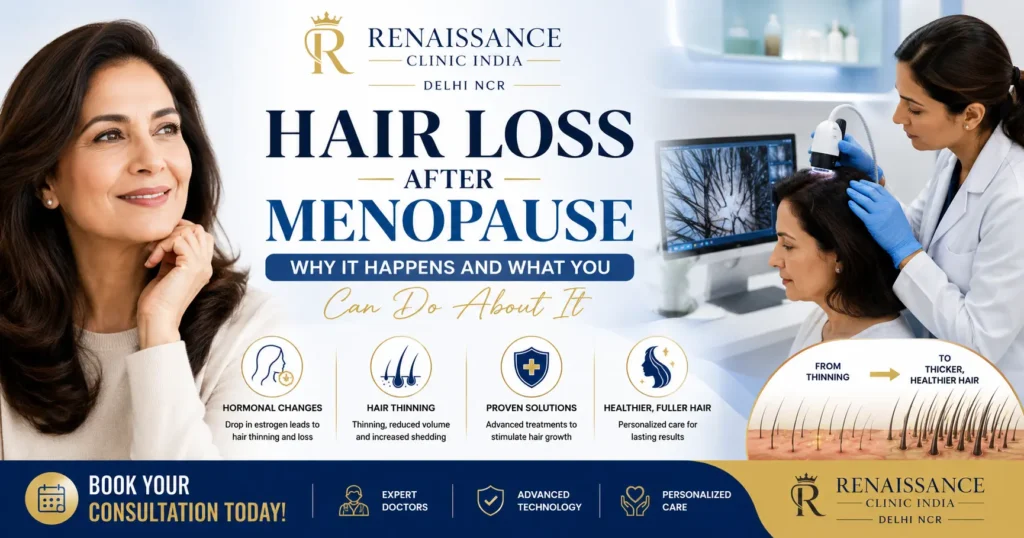
1. Understanding Hair Loss After Menopause — You Are Not Alone
Hair loss after menopause is one of the most common — and most quietly distressing — changes that women experience during this stage of life. If you have noticed a widening parting, more strands on your pillow, or a ponytail that feels noticeably thinner than it used to, you are far from alone. Research suggests that around half of women going through the menopause transition, and as many as 80% of postmenopausal women, notice some degree of hair thinning.
Despite how common it is, this topic rarely gets the attention it deserves. Conversations about menopause tend to focus on hot flushes, sleep, and mood — while changes to hair density, texture, and growth are often dismissed as a minor cosmetic issue or simply ‘part of getting older.’ For many women, however, the impact on confidence and self-image is significant and entirely valid.
At Renaissance Clinic India, we see women every week who have lived with gradual hair thinning for years before seeking help — often because they assumed nothing could be done, or because they did not know where to start. The reality is that this type of hair loss is well understood medically, has multiple effective treatment pathways, and responds best when addressed early.
This guide explains exactly why hormonal changes during this life stage affect hair, what the most common patterns look like, and — most importantly — the full range of solutions, from simple lifestyle adjustments to advanced clinical treatments available right here in Delhi NCR.
Quick Facts Every Woman Should Know • Hormonal hair changes can begin up to 10 years before menopause itself — during perimenopause • The most common pattern is diffuse thinning at the crown and a widening centre parting • This type of hair loss is rarely sudden — it develops gradually over months to years • Early intervention significantly improves outcomes — waiting allows follicles to shrink further • Multiple effective options exist: topical treatments, PRP therapy, microneedling, and more |
2. Why It Happens: The Hormonal Science Explained
To understand why hair changes so noticeably during this stage of life, it helps to understand the role that hormones play in the natural hair growth cycle — and what happens when that balance shifts.
The Role of Estrogen in Healthy Hair Growth
Estrogen has a protective, growth-supporting effect on hair follicles. It helps extend the anagen phase — the active growth phase of the hair cycle — meaning hairs stay on the scalp longer before shedding and being replaced. Estrogen also helps shield hair follicles from the effects of androgens, the hormones more commonly associated with male pattern baldness.
As estrogen production declines during the menopause transition, this protective effect weakens. The growth phase shortens, hairs are replaced less efficiently, and over time the overall volume and density of the hair can visibly reduce.
The Rise of Androgens and DHT
Estrogen and progesterone do not simply disappear during menopause — they decline relative to androgens such as testosterone, which remain comparatively more present. A by-product of testosterone called dihydrotestosterone (DHT) can bind to receptors in hair follicles, particularly at the crown and frontal scalp, causing the follicles to gradually shrink — a process called follicular miniaturisation.
Over successive growth cycles, miniaturised follicles produce shorter, finer, and less pigmented hairs. This is the underlying mechanism behind female pattern hair loss, also known as androgenetic alopecia, which becomes substantially more common after menopause.
Telogen Effluvium — A Different, Often Temporary Pattern
Some women experience a different phenomenon: a sudden increase in shedding, sometimes triggered by the hormonal upheaval of perimenopause itself, or by associated stress, illness, or significant weight change. This is known as telogen effluvium — a larger-than-normal proportion of hairs entering the shedding (telogen) phase at the same time.
Unlike female pattern hair loss, telogen effluvium is often temporary, and normal density can return once the underlying trigger resolves — though this can take several months. Distinguishing between these two patterns is an important part of any professional assessment.
Why This Matters: Two Different Patterns, Two Different Approaches Female pattern hair loss (androgenetic alopecia) is progressive and benefits from early, ongoing treatment to slow follicular miniaturisation. Telogen effluvium is often self-limiting but benefits from nutritional support and addressing the underlying trigger. Many women experience a combination of both during the menopause transition — which is why a proper assessment matters more than guesswork or generic over-the-counter products. |
3. 7 Common Causes and Patterns of Menopausal Hair Thinning
Hair loss after menopause is rarely caused by a single factor in isolation. Here are the seven contributors our physicians most commonly identify during consultations:
Cause | How It Affects Hair | Typical Pattern |
Declining estrogen & progesterone | Shortens the active growth phase; reduces follicle protection from androgens | Gradual diffuse thinning over months to years |
Relative rise in androgens (DHT) | Causes follicular miniaturisation, particularly at the crown and frontal scalp | Widening centre parting, crown thinning |
Telogen effluvium | Triggers a temporary surge in hair shedding | Sudden increased shedding, often diffuse |
Nutrient deficiencies | Iron, vitamin D, B vitamins, zinc and protein are essential cofactors for hair growth | Generalised thinning, brittle strands |
Reduced sebum production | Drier scalp and hair shaft, increased breakage | Dry, brittle, frizzy-feeling hair |
Thyroid changes | Thyroid dysfunction becomes more common with age and can independently affect hair | Diffuse thinning, sometimes with other symptoms (fatigue, weight changes) |
Chronic stress and sleep disruption | Elevated cortisol can push more follicles into the resting phase | Increased shedding, often layered on top of hormonal thinning |
4. How to Tell If It Is Menopause-Related or Something Else
Not all hair loss in midlife is hormonal. Before assuming hair loss after menopause is the explanation, it is worth understanding the patterns that suggest a hormonal cause — and the signs that warrant a broader medical evaluation.
Signs Suggesting a Hormonal (Menopausal) Pattern
- Gradual thinning that has developed slowly over months or years, rather than appearing suddenly
- A widening centre parting or visibly thinner crown, while the hairline itself often remains relatively intact
- Hair that feels finer, softer, or less voluminous overall, even if total hair loss seems modest
- Onset coinciding with other menopause symptoms — irregular periods, hot flushes, sleep changes
- A family history of similar pattern thinning in female relatives
Signs That Warrant Broader Investigation
- Patchy, well-defined bald spots — this can indicate alopecia areata, an autoimmune condition unrelated to hormones
- Hair loss accompanied by scalp pain, itching, redness, or scaling — may indicate a scalp condition requiring dermatological treatment
- Sudden, dramatic shedding over a period of weeks — may indicate telogen effluvium triggered by illness, surgery, medication change, or significant stress
- Hair loss accompanied by other new symptoms — unexplained weight change, fatigue, palpitations — may indicate thyroid or other systemic involvement
When to See a Specialist If you are uncertain which pattern applies to you, a professional scalp assessment is the most reliable way forward. At Renaissance Clinic India, our initial consultation includes trichoscopy — a magnified examination of your scalp and hair follicles — along with a review of your medical history, recent life changes, and where relevant, basic blood work to check iron, vitamin D, and thyroid function. This assessment helps us understand precisely what is driving your hair changes, so that any treatment plan addresses the actual cause rather than guessing. |
5. What You Can Do: Medical and Lifestyle Solutions
The encouraging reality is that this type of hair loss responds well to a combination of approaches — most women see meaningful improvement when several strategies are used together rather than relying on a single product or treatment.
Topical Treatments
Minoxidil remains one of the most well-studied topical treatments for thinning hair in women. Applied directly to the scalp, it helps prolong the growth phase of the hair cycle and can improve density with consistent, ongoing use. Results are gradual — typically visible after 3-6 months of regular application — and benefits are generally maintained only with continued use.
Nutritional Support
Because nutrient deficiencies can compound hormonal hair thinning, addressing iron levels, vitamin D, B vitamins (including biotin), zinc, and overall protein intake is an important foundation. A simple blood panel can identify any deficiencies, allowing for targeted supplementation rather than guessing which supplement might help.
Scalp Care and Gentle Hair Practices
As oil production naturally decreases, switching to gentler shampoos, reducing heat styling, and incorporating regular scalp massage can help minimise additional breakage and support a healthier scalp environment for existing follicles.
Medical Consultation for Hormonal Options
Some women explore hormone therapy as part of managing broader menopause symptoms, and there is emerging research into its effects on hair specifically — though current evidence remains limited compared to other menopause symptoms. This is a decision to make in partnership with a qualified physician who can weigh your overall health profile, as hormone therapy involves considerations well beyond hair alone.
Botanical and Adjunct Approaches
Recent research has explored botanical ingredients such as saw palmetto, which may help reduce DHT activity, and rosemary oil, studied for its effects on scalp circulation. While these are generally considered gentler, supportive options, they are most effective as part of a broader plan rather than a standalone solution.
6. Advanced Treatments Available at Renaissance Clinic India
For women seeking more than topical and lifestyle measures, several clinical treatments have shown meaningful results for hormonal hair thinning. At Renaissance Clinic India, we offer the following options, individually or in combination, based on your specific assessment:
Treatment | How It Helps | What to Expect |
PRP (Platelet-Rich Plasma) Therapy | Concentrated growth factors from your own blood are injected into the scalp to stimulate follicle activity and improve density | Series of sessions, typically spaced 4-6 weeks apart; gradual improvement over 3-6 months |
Microneedling | Creates controlled micro-channels in the scalp that can enhance absorption of topical treatments and stimulate a mild healing response | Often combined with PRP or topical minoxidil for enhanced effect |
GFC (Growth Factor Concentrate) | Similar principle to PRP, using a concentrated preparation of growth factors to support follicle health | Series of sessions tailored to individual response |
Personalised Topical Protocols | Combination formulations addressing density, scalp health, and follicle support based on your assessment | Daily application as part of an ongoing routine |
Nutritional Optimisation Plans | Blood-test-guided supplementation to correct deficiencies that may be compounding hair thinning | Reassessment after 3 months to track improvement |
Every treatment plan at Renaissance Clinic India begins with a thorough assessment — we do not recommend treatments without first understanding what is driving your specific pattern of hair loss. This honest, individualised approach is why women across Delhi NCR trust us with this deeply personal concern.
7. Building a Personalised Hair Recovery Plan — What to Expect
If you are ready to take the next step, here is what the process looks like at Renaissance Clinic India:
- Comprehensive Consultation: A detailed conversation about your hair history, the timeline of changes you have noticed, your broader menopause symptoms, and any relevant medical history. This is followed by trichoscopy — a magnified scalp examination — to assess follicle density and pattern.
- Targeted Investigations (If Needed): If indicated, simple blood tests check iron, vitamin D, thyroid function, and other relevant markers — ensuring any treatable nutritional or medical contributors are identified.
- Personalised Treatment Plan: Based on your assessment, we recommend a combination of approaches suited to your pattern — which may include topical treatments, PRP or microneedling sessions, nutritional guidance, and scalp care adjustments.
- Ongoing Monitoring: Hormonal hair changes respond gradually. We schedule follow-up assessments — typically at 3 and 6 months — to track progress through photographs and trichoscopy, and adjust the plan as needed.
- Long-Term Maintenance: Because this is a hormonally driven, ongoing process for many women, maintenance treatments help sustain results over time — much like managing any other long-term aspect of health.
A Note on Timelines and Expectations Hair growth is a slow biological process — the hair growth cycle itself spans months, which means meaningful visible improvement typically takes 3-6 months of consistent treatment, sometimes longer. Complete reversal to pre-menopausal density is not always realistic, but significant, visible improvement in thickness, coverage, and hair health is achievable for most women with the right combination of approaches. The most important first step is simply starting — earlier intervention generally produces better outcomes than waiting, because follicles that have not yet become permanently dormant respond better to stimulation. |
8. Frequently Asked Questions
Q1. Is hair loss after menopause permanent?
It depends on the underlying cause and how early it is addressed. Female pattern hair loss tends to be progressive without intervention, but treatment can slow progression significantly and often improve density. Telogen effluvium related to hormonal fluctuation is often temporary and can resolve on its own, though this may take many months. A professional assessment helps clarify which pattern applies to you and what outcome is realistic.
Q2. At what age does menopausal hair loss typically begin?
Hormonal changes affecting hair can begin during perimenopause — sometimes up to a decade before menopause itself, which is typically experienced around age 45-55. Many women first notice subtle changes in their early to mid-40s, though the timeline varies considerably between individuals.
Q3. Can hair transplant surgery help with this type of hair loss?
Hair transplantation can be an option for some women with stable, well-defined areas of thinning and adequate donor hair density, but it is generally considered after other approaches have been explored, and is most suitable for specific patterns rather than diffuse, ongoing thinning. A thorough assessment at Renaissance Clinic India will clarify whether you are a suitable candidate, and which approach — surgical or non-surgical — best fits your situation.
Q4. Will hair loss after menopause affect my entire scalp, or just certain areas?
The most common pattern is diffuse thinning that is most noticeable at the crown and along the centre parting, while the frontal hairline often remains relatively preserved — unlike typical male pattern baldness. However, patterns vary between individuals, and some women experience more generalised thinning across the whole scalp.
Q5. Do I need blood tests before starting treatment?
While not always essential, basic blood tests checking iron, vitamin D, and thyroid function are often recommended because deficiencies in these areas are common during midlife and can significantly compound hormonal hair thinning. Identifying and correcting any deficiencies gives any other treatment the best chance of success.
Q6. How soon can I expect to see results from treatment?
Because hair growth follows a slow biological cycle, most women begin to notice reduced shedding within 6-8 weeks of starting a consistent treatment plan, with visible improvements in density typically emerging over 3-6 months. Photographic tracking at follow-up visits helps capture gradual changes that can be difficult to notice day to day.
Conclusion: You Do Not Have to Navigate This Alone
Hair loss after menopause is a real, common, and treatable part of this life stage — not something you need to simply accept or hide. Understanding the hormonal shifts behind it is the first step toward addressing it with confidence rather than guesswork.
Whether your thinning is gradual and pattern-based, sudden and shedding-related, or a combination of both, there is a path forward — and it begins with an honest, thorough assessment rather than another over-the-counter product that may not be suited to your specific situation.
At Renaissance Clinic India, our physicians combine clinical expertise with genuine understanding of how deeply this concern can affect women during an already transitional time of life. We are here to listen, assess, and build a plan that is realistic, evidence-based, and entirely your own.
Take the First Step — Hair Assessment at Renaissance Clinic India Trichoscopy scalp analysis + personalised treatment plan + honest guidance PRP Therapy | Microneedling | Nutritional Plans | Advanced Hair Restoration Renaissance Clinic India | Women’s Hair Health Programme | Delhi NCR www.renaissanceclinicindia.com Serving: Delhi | Noida | Gurgaon | Ghaziabad | Faridabad | All NCR |
Renaissance Clinic India | renaissanceclinicindia.com | Trusted Hair & Aesthetic Care Across Delhi NCR
Copyright 2026 Renaissance Clinic India. All rights reserved. Results may vary by individual. This content is informational only and does not constitute medical advice. Consult a qualified physician for personalised guidance.