
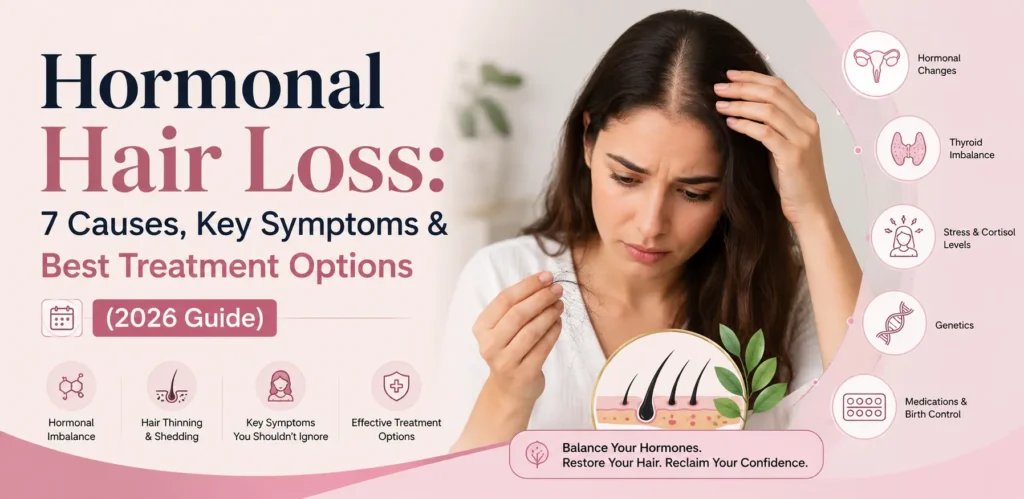
Hair fall can feel sudden and unexplained — but in most cases, your hormones are telling a story. Hormonal hair loss is one of the most frequently seen yet most under-diagnosed conditions in dermatology clinics across India. Whether it is postpartum shedding, thyroid dysfunction, or the gradual thinning seen with age, the root of the problem is often biochemical rather than cosmetic.
At Renaissance Clinic India, we see patients across age groups who have spent months applying oils and serums without results — simply because the underlying imbalance was never addressed. This 2026 guide walks you through the science, the signals to watch for, and the treatment pathways that actually work.
1. What Is Hormonal Hair Loss?
Hair loss driven by shifts in the body’s hormonal environment is medically referred to as endocrine-related alopecia. It differs from nutritional deficiency or stress-related shedding in that it follows a pattern closely tied to hormonal events — puberty, pregnancy, menopause, thyroid disease, or androgen excess.
Unlike generalised shedding that resolves on its own, hormonal disruption can progressively miniaturise hair follicles over time. Left untreated, this results in permanent thinning — which is why early identification is essential.
2. How Hormones Affect Your Hair Growth Cycle
Every hair on your scalp follows a three-stage cycle: anagen (active growth), catagen (transition), and telogen (resting and shedding). Hormonal fluctuations disrupt the balance between these phases.
Here is what the disruption looks like in practice:
- Androgens like DHT (dihydrotestosterone) shorten the anagen phase, leading to finer, shorter hairs over successive cycles.
- Oestrogen withdrawal — such as after delivery or during perimenopause — pushes large numbers of follicles into the telogen phase simultaneously.
- Thyroid hormones regulate cellular metabolism, including in hair follicles. Both excess and deficiency cause diffuse thinning.
- Cortisol, the stress hormone, when chronically elevated, suppresses anagen signalling and accelerates the resting phase.
3. 7 Common Hormonal Causes of Hair Loss
Understanding the specific trigger is the first step towards effective treatment. Below are the seven most prevalent hormonal causes seen at our clinic.
Androgenetic Alopecia (AGA)
Often called male or female pattern baldness, AGA is driven by genetic sensitivity to DHT. In men, it typically begins at the temples and crown. In women, it manifests as a widening part line with diffuse thinning over the central scalp. Both sexes carry androgen receptors in scalp follicles — when DHT binds to these receptors, the growth cycle shortens progressively.
Polycystic Ovary Syndrome (PCOS)
PCOS is a leading cause of female hair thinning in the reproductive years. Elevated androgens suppress oestrogen’s protective effect on follicles. Women with PCOS often notice simultaneous shedding at the scalp and increased facial or body hair growth — a pattern that points directly to androgen excess.
Thyroid Dysfunction
Both hypothyroidism (underactive) and hyperthyroidism (overactive) disrupt the hair growth cycle. Thyroid-related thinning is typically diffuse, affecting the entire scalp rather than a defined area. Patients may also notice brittle, dry hair, eyebrow loss, and changes in hair texture before shedding becomes visible.
Postpartum Hair Loss
During pregnancy, elevated oestrogen keeps most follicles anchored in the anagen phase — resulting in the thick, lustrous hair many women notice. After delivery, oestrogen drops sharply, and those retained follicles enter telogen simultaneously. The result is a wave of shedding that typically peaks between two and four months postpartum and generally resolves within a year.
Menopause and Perimenopause
As oestrogen and progesterone decline with age, androgens gain relative dominance. This hormonal shift progressively reduces follicle size, resulting in finer, thinner hair over the crown and frontal scalp. Menopausal hair changes are gradual and easy to overlook until significant density has already been lost.
Insulin Resistance and Metabolic Syndrome
Chronically elevated insulin levels stimulate androgen production in the ovaries and adrenal glands. Patients with insulin resistance — even without a formal diabetes diagnosis — can experience significant androgenic thinning. This is particularly common in individuals with PCOS, obesity, or a sedentary lifestyle.
Adrenal Disorders and Chronic Stress
The adrenal glands produce both cortisol and androgens. In conditions like congenital adrenal hyperplasia or adrenal tumours, androgen excess triggers follicle miniaturisation. Even without pathology, sustained psychosocial stress raises cortisol and suppresses growth-phase signalling — a mechanism that explains why many patients report noticeable shedding during prolonged stressful periods.
4. Symptoms: How to Recognise Hormonal Thinning
Hormonal thinning often develops slowly, which makes it easy to attribute to other causes. Watch for these specific signs:
- Widening of the central part line (most common pattern in women)
- Increased hair visible on the pillow, in the shower drain, or on hairbrush
- Scalp becoming more visible under direct light
- Hair feeling noticeably finer or lighter in density
- Receding hairline or temple thinning (more common in men and some women with PCOS)
- Changes in hair texture — drier, more brittle, or slower to grow
- Associated symptoms such as fatigue, weight changes, irregular periods, or acne (which point to systemic hormonal issues)
One useful self-check is the pull test: gently grasp 40–60 hairs and pull slowly along the length. Losing more than 5–6 hairs consistently suggests active telogen effluvium, which often has a hormonal component.
5. Diagnosis: Tests You Should Ask For
A visual consultation alone is rarely sufficient. At Renaissance Clinic India, we combine clinical assessment with targeted blood investigations to map the hormonal landscape before recommending any treatment. Key tests include:
- Complete blood count (CBC) — to rule out anaemia
- Thyroid profile (TSH, Free T3, Free T4)
- Serum ferritin and iron studies
- Hormonal panel: testosterone (total and free), DHEA-S, LH, FSH, prolactin
- Fasting insulin and glucose (HOMA-IR for insulin resistance)
- Vitamin D and B12 levels
- Trichoscopy — a non-invasive scalp examination tool that reveals miniaturisation patterns not visible to the naked eye
These investigations allow us to distinguish between androgenetic alopecia, telogen effluvium, and other pattern-forming conditions — a distinction that directly determines the treatment plan.
6. Best Treatment Options in 2026
Treatment for hormonally driven hair loss requires a layered approach. No single solution addresses every element of the problem. Effective management usually combines medical therapy, in-clinic procedures, and lifestyle modification.
Topical Minoxidil
Minoxidil remains a first-line intervention for androgenetic pattern loss. Applied directly to the scalp, it prolongs the anagen phase and improves blood flow to follicles. Available in 2% and 5% concentrations for women, and 5% for men, results typically become visible at the three to six month mark with consistent use.
Anti-Androgen Medications
Finasteride (for men) and spironolactone or flutamide (for women) work by blocking androgen activity at the follicle level or reducing DHT production. These are prescription-only medications that require monitoring — but for patients with confirmed androgen-driven thinning, they can halt progression effectively.
Platelet-Rich Plasma (PRP) Therapy
PRP involves drawing a small amount of the patient’s blood, concentrating the platelets, and injecting this growth factor-rich serum into the scalp. Platelets release proteins that stimulate dormant follicles and improve scalp vascularity. PRP is particularly effective in early-to-moderate androgenetic alopecia and when combined with medical therapy. At Renaissance Clinic India, we offer standardised PRP protocols with documented outcomes.
Low-Level Laser Therapy (LLLT)
LLLT devices deliver photobiomodulation — using specific wavelengths of light to energise follicular cells and extend their active growth phase. Multiple clinical studies have demonstrated its efficacy as an adjunctive treatment for androgenetic thinning. Devices range from in-clinic laser domes to FDA-cleared home use caps and combs.
Hormonal Regulation Through Endocrinology
For patients with diagnosed thyroid disorders, PCOS, adrenal issues, or perimenopause-related decline, working with an endocrinologist to stabilise the underlying imbalance is essential. Hair regrowth often follows once the hormonal environment is corrected — whether through thyroid replacement therapy, insulin sensitisers like metformin, or tailored hormone therapy.
Hair Transplant Surgery
In cases where significant miniaturisation has already occurred and follicles in the affected zones are no longer viable, hair transplant surgery offers a permanent solution. Techniques such as FUE (Follicular Unit Excision) and DHI (Direct Hair Implantation) allow precise restoration of density. It is important to note that a transplant is most successful when the hormonal cause is stabilised — performing surgery on an unstable scalp may compromise long-term results.
Nutraceuticals and Micronutrient Correction
Deficiencies in iron, ferritin, Vitamin D, zinc, and biotin are frequently co-existing factors that worsen hormonally driven thinning. Correcting these deficiencies — either through diet or supplementation — creates a more receptive environment for follicular recovery. At our clinic, supplementation is guided by actual blood levels rather than guesswork.
7. Lifestyle Changes That Support Recovery
Medical treatment works best when paired with sustainable lifestyle habits. These changes directly influence hormonal regulation:
- Reduce refined sugar and processed carbohydrates — spikes in insulin drive androgen production.
- Incorporate regular resistance training — shown to improve insulin sensitivity and reduce DHEA-related androgen excess.
- Prioritise sleep — growth hormone peaks during deep sleep and plays a role in follicular repair.
- Manage chronic stress with structured approaches (meditation, breathwork, reduced screen time before bed).
- Avoid crash dieting — caloric restriction creates a physiological stress response that accelerates shedding.
- Use mild, sulphate-free shampoos — aggressive cleansing strips scalp oils that contribute to follicular health.
- Limit excessive heat styling — thermal damage weakens existing hair shafts that are already finer due to miniaturisation.
8. When to See a Specialist
Consult a dermatologist or trichologist if you notice any of the following:
- You are losing more than 100–150 hairs per day consistently over several weeks
- Hair fall is accompanied by other systemic symptoms (fatigue, weight gain, menstrual irregularity, acne)
- You have been managing hair loss at home for three or more months without improvement
- Your scalp is becoming visibly thinner or patches are forming
- You have a family history of early or significant hair loss
Early intervention makes a measurable difference. Hair follicles that are miniaturised but not yet destroyed can often be rescued with targeted treatment. Waiting until the shedding is severe dramatically reduces the range of effective options. Book a trichology consultation at Renaissance Clinic India to get a complete hormonal and scalp assessment.
9. FAQs About Hormonal Hair Loss
Can hormonal hair loss be reversed completely?
In many cases, yes — particularly when the cause is temporary (postpartum, medication-induced, or related to a correctable hormonal condition). For androgenetic alopecia, treatment can halt progression and improve density, but results require consistent maintenance.
How long does it take to see results from treatment?
Hair cycles are slow. Most patients see measurable improvement after three to six months of consistent treatment. Visible density gains from PRP or LLLT are typically evident at the six-month mark. Patience and compliance are critical.
Is hormonal thinning different in men and women?
Yes. In men, androgenetic alopecia typically follows the Norwood scale — receding temples and crown thinning. In women, the Ludwig scale applies — diffuse thinning over the crown with the frontal hairline largely preserved. Women also experience a broader range of systemic hormonal triggers, making diagnosis more complex.
Are hair supplements enough to treat hormonal thinning?
Supplements address co-existing nutritional deficiencies but do not correct hormonal imbalances. Biotin, for example, supports hair structure but does not block DHT or regulate thyroid hormones. Supplements work best as part of a comprehensive treatment plan, not as a standalone approach.
What is the link between birth control and hair loss?
Certain oral contraceptives with high androgenic progestins can accelerate follicle miniaturisation in women genetically predisposed to AGA. Conversely, stopping hormonal contraception can trigger a temporary shedding episode as the body readjusts. Discussing this with both a gynaecologist and a dermatologist is advisable.
Conclusion
Hormonal hair loss is not simply a cosmetic inconvenience — it is a visible signal from your body that something in its internal chemistry needs attention. With the right diagnostic framework and a personalised treatment plan, most patients achieve meaningful improvement.
The key is to stop waiting for the shedding to resolve on its own and take an informed, evidence-based approach. Whether you are in the early stages of PCOS-related thinning, navigating postpartum loss, or dealing with progressive androgenetic alopecia — the sooner you act, the broader your options.
Renaissance Clinic India offers comprehensive trichology consultations, hormonal assessments, and advanced hair restoration services. To book your consultation, visit renaissanceclinicindia.com.
References & Further Reading
American Academy of Dermatology Association — Hair Loss: https://www.aad.org/public/diseases/hair-loss