
Medically reviewed for Renaissance Clinic India, Indirapuram, Ghaziabad
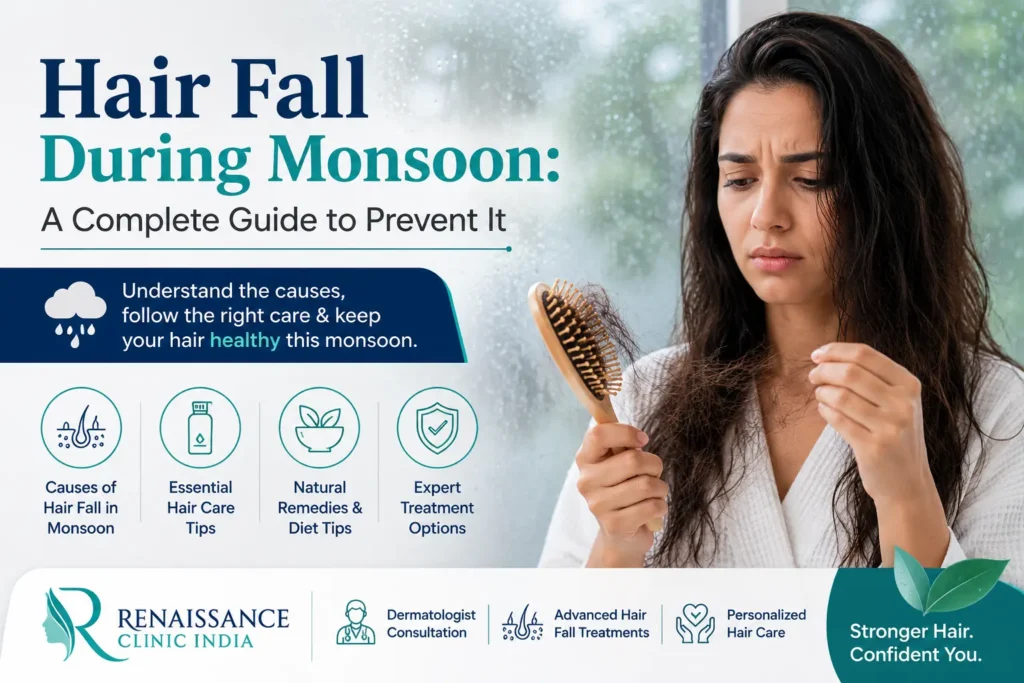
Every year, as the first showers hit Delhi NCR, our clinic sees the same pattern: a noticeable jump in patients asking about hair fall during monsoon. It isn’t in your head, and it isn’t just one thing — humidity, rainwater, and scalp infections all pile on at the same time, and most people are only fighting one of them.
This guide breaks down exactly why the rains are so hard on your hair, what a proper monsoon hair care routine looks like, and how to know when shedding has crossed the line from seasonal to something worth getting checked.
None of what follows requires an expensive overhaul of your routine — most of it is about timing, gentleness, and catching small scalp issues before they become bigger ones.
What You’ll Learn in This Article
- Why Hair Fall Spikes When the Rains Arrive
- The Science Behind Monsoon Hair Damage
- 5 Hidden Triggers Most People Overlook
- 9 Tips to Prevent Hair Fall During Monsoon
- Nutrients That Support Hair During the Rainy Season
- Monsoon Hair Care Mistakes to Avoid
- Home Remedies Worth Trying
- Adjusting Your Routine by Hair Type
- When Monsoon Shedding Signals Something More
- Final Verdict
- Frequently Asked Questions
Why Hair Fall Spikes When the Rains Arrive
Three things converge during the monsoon to put extra stress on your scalp and strands. First, the air itself changes — humidity levels climb sharply, and hair reacts to that shift whether or not you ever step outside. Second, when you do step outside, rainwater in Indian cities typically carries dust, vehicle pollutants, and surface run-off that wasn’t part of the water cycle a century ago. Third, the same warm, damp conditions that make umbrellas useless also happen to be perfect breeding ground for scalp fungus and bacteria.
Put those three together — atmospheric humidity, contaminated rainwater, and microbial overgrowth — and it’s easy to see why hair fall during monsoon feels so much worse than the rest of the year, even for people who don’t normally struggle with shedding.
In Delhi NCR specifically, the effect can be more pronounced. Urban rainwater picks up road dust, vehicle exhaust residue, and construction particulates on its way down, and many homes in Ghaziabad and surrounding areas already rely on mineral-heavy groundwater the rest of the year. When monsoon runoff mixes into that supply, hair that’s already coping with hard water gets a second layer of stress during the wettest months.
The Science Behind Monsoon Hair Damage
There’s an actual mechanism behind the frizz-and-breakage cycle so many people notice in the rains. Dermatology sources describe it as hygral fatigue — repeated swelling and shrinking of the hair shaft as it absorbs and releases moisture. Each cycle puts mechanical stress on the cuticle, and over weeks of humid weather, that stress adds up to visible breakage, not just root-level shedding.
This matters because it reframes the problem: some of what looks like monsoon hair loss is actually mid-strand snapping from repeated swelling, not follicles giving up. The two often happen together, which is exactly why the rainy season feels like a losing battle for hair health.
5 Hidden Triggers Most People Overlook
Beyond the obvious humidity-and-rain combination, a few less-discussed factors quietly make monsoon hair fall worse:
- Helmet and scarf sweat: Riding a two-wheeler in the rain traps sweat and moisture against the scalp for hours, creating the same warm, damp conditions fungus thrives in.
- Delayed hair drying: Tying up damp hair or sleeping with a wet scalp keeps follicles in a constantly moist state, which weakens the anchoring of each strand.
- Over-washing to feel “clean”: Washing daily to combat the sticky, humid feeling strips natural scalp oils, leaving skin more vulnerable to irritation.
- Skipping oil and protein in the diet: Monsoon cravings often lean toward fried, carb-heavy comfort food, quietly pushing out the protein and iron your hair actually needs.
- Reduced sun exposure: Less sunlight during overcast weeks can lower Vitamin D synthesis, a nutrient increasingly linked to healthy hair cycling.
9 Tips to Prevent Hair Fall During Monsoon
None of these require expensive products — just consistency through the wettest months of the year.
- Rinse immediately after getting rained on. Don’t let rainwater sit on your scalp; a quick rinse with clean water removes most surface pollutants.
- Dry your scalp fully before tying your hair up. Damp roots under a tight bun are exactly what fungal infections need to take hold.
- Switch to a mild, sulphate-free shampoo. This keeps the scalp clean without stripping the oils that protect it during humid weeks.
- Space out washes to 2–3 times a week. Over-washing during monsoon does more harm than good; find a rhythm that keeps the scalp clean, not stripped.
- Detangle only with a wide-tooth comb, and only when hair is damp, not soaking wet, since wet hair is at its weakest.
- Skip tight hairstyles for the season. Ponytails and buns pull on already-weakened strands; looser styles reduce that tension.
- Use a lightweight leave-in or serum, not a heavy conditioner, to avoid tipping already-swollen hair further into hygral fatigue.
- Keep a travel-size antifungal or medicated shampoo on hand if you notice flaking, itching, or odour developing on the scalp.
- Protect coloured or chemically treated hair with a UV and humidity-resistant serum, since processed hair is more porous and reacts faster to moisture swings.
Nutrients That Support Hair During the Rainy Season
Hair care from the outside can only do so much if the diet isn’t supporting follicle health from within. These are the nutrients worth prioritising through the monsoon months:
Nutrient | Why It Matters | Good Sources |
Protein | Hair is built from keratin, a structural protein | Eggs, lentils, paneer, fish |
Iron | Low iron is a common, correctable cause of shedding | Spinach, chickpeas, jaggery, pumpkin seeds |
Omega-3s | Supports scalp hydration and reduces inflammation | Walnuts, flaxseed, fatty fish |
Zinc & Biotin | Support follicle repair and the hair growth cycle | Nuts, whole grains, sweet potato |
Alongside these, don’t underestimate water intake — humid weather can mask dehydration since you sweat without always noticing it, and a dehydrated scalp is a drier, more fragile one.
Monsoon Hair Care Mistakes to Avoid
- Brushing hair vigorously while it’s still dripping wet
- Using the same brush or comb without cleaning it for weeks at a time
- Relying on heat styling to “fix” frizz caused by humidity
- Ignoring early flaking or itching, assuming it will pass on its own
- Wearing damp caps or helmets repeatedly without washing them
Home Remedies Worth Trying
A few traditional practices genuinely hold up during monsoon, alongside the routine changes above:
- Warm oil massage: Coconut or almond oil, warmed slightly and massaged in once or twice a week, improves scalp circulation and helps offset dryness between washes.
- Diluted apple cider vinegar rinse: Used occasionally after shampooing, it can help balance scalp pH and reduce the buildup that contributes to itching.
- Neem-based scalp treatments: Neem’s natural antifungal properties make it a reasonable, low-cost option for people prone to monsoon dandruff.
These remedies support a good routine — they don’t replace one, and they won’t resolve hair fall that has a medical cause.
Adjusting Your Routine by Hair Type
Oily scalp
Humidity tends to make an oily scalp feel worse faster. Stick to a mild shampoo every 2–3 days rather than skipping washes to “save” hair, since built-up oil combined with monsoon sweat is a common trigger for scalp irritation.
Dry or chemically treated hair
Processed and dry hair is more porous, so it absorbs atmospheric moisture faster and is more prone to hygral fatigue. Lean on lightweight leave-in serums rather than heavy oils before stepping out, and reserve deep conditioning for once a week rather than daily.
Curly or wavy hair
Curl patterns are especially reactive to humidity swings. A light anti-humidity serum applied to damp hair, followed by air-drying instead of towel-roughing, helps curls hold their shape without over-absorbing moisture from the air.
Coloured hair
Colour-treated strands lose moisture and pigment faster once the cuticle is compromised. Use sulphate-free, colour-safe shampoos through the season and avoid vigorous towel-drying, which accelerates both fading and breakage.
When Monsoon Shedding Signals Something More
Some increase in shedding during the rains is normal and temporary. But certain signs suggest it’s time to move past home care and get a professional opinion:
- Hair fall that continues well after the season ends
- Visible thinning, a widening parting, or bald patches
- Persistent scalp redness, pain, or an odour that doesn’t resolve with antifungal shampoo
- Clumps of hair coming out from the root rather than scattered breakage
At Renaissance Clinic India, our dermatology and hair specialists can tell the difference between seasonal shedding and an underlying condition like androgenetic alopecia, telogen effluvium, or a scalp infection that needs targeted treatment. If your hair fall during monsoon isn’t settling down, book a scalp consultation at our Indirapuram, Ghaziabad clinic.
Final Verdict
Hair fall during monsoon is real, common, and largely manageable. Humidity, rainwater exposure, and fungal risk genuinely do more damage to hair in these months than in drier weather, but a consistent routine — gentle washing, prompt drying, the right diet, and quick action on early scalp symptoms — resolves most of it without any medical intervention.
The exception is shedding that doesn’t ease up once the season changes. That’s your cue to stop experimenting and get a proper scalp assessment instead.
Frequently Asked Questions
Is it normal for hair fall to increase during monsoon?
Yes, a moderate increase is common and usually temporary, driven by humidity, rainwater exposure, and higher scalp infection risk during the season.
How often should I wash my hair during monsoon?
Two to three times a week with a mild shampoo is usually enough to keep the scalp clean without stripping its natural protective oils.
Does tying wet hair really cause more hair fall?
Yes. Wet hair is structurally weaker, and tying it up adds tension at exactly the point it’s most likely to snap or pull from the root.
Can diet alone fix monsoon hair fall?
Diet supports hair health but works best alongside good scalp hygiene and hair care habits — on its own, it usually isn’t enough to fully offset humidity-related damage.
When should monsoon hair fall worry me?
If shedding continues after the season ends, or if you notice visible thinning, bald patches, or persistent scalp irritation, it’s time to consult a hair specialist rather than wait it out.
Are anti-hair-fall shampoos worth using during monsoon?
Mild, sulphate-free shampoos marketed for hair fall can help by being gentler on an already stressed scalp, but they work best as one part of a full routine rather than a standalone fix. Look for formulas that clean effectively without over-stripping natural oils, since that balance matters more during monsoon than any specific ingredient claim.
Renaissance Clinic India is a trusted hair and skin clinic in Ghaziabad and Indirapuram, offering scalp diagnostics, dermatology consultations, and advanced hair restoration for seasonal and long-term hair fall. Visit renaissanceclinicindia.com to learn more or book your consultation today.