
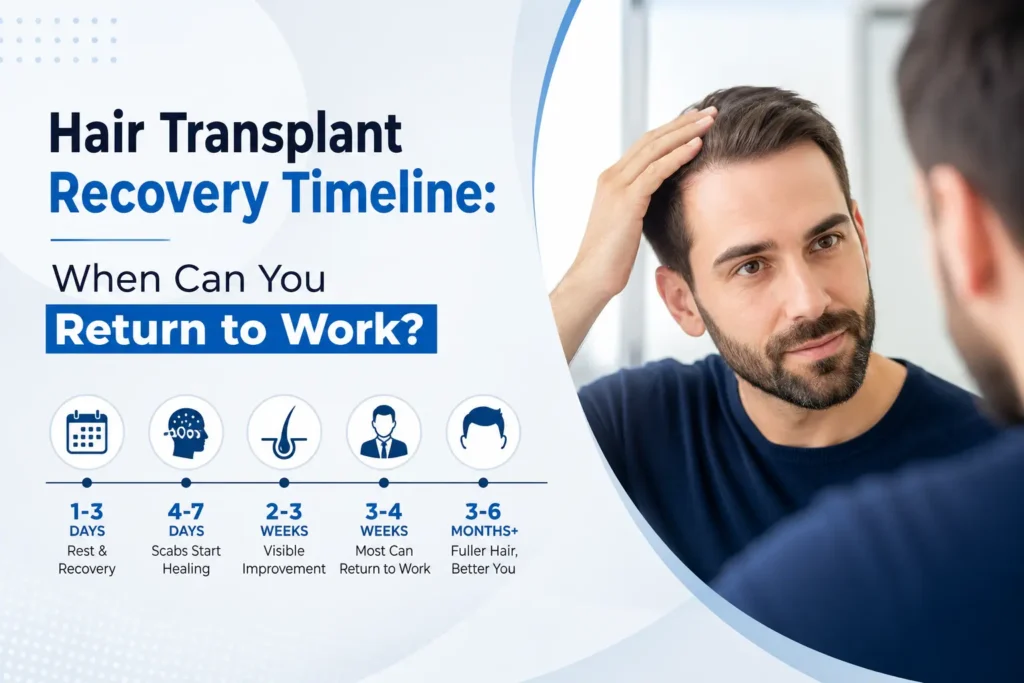
So you’ve booked your hair transplant — or you’re seriously considering one — and now the practical questions are kicking in. How much downtime do you actually need? When can you go back to the office without people staring at your scalp? When will you finally see real hair growth instead of redness and scabs?
This guide breaks down the complete hair transplant recovery timeline week by week, so you know exactly what to expect and can plan your work schedule with confidence.
1. Understanding the Hair Transplant Recovery Process
A hair transplant isn’t a single event — it’s a healing process that unfolds in stages over roughly 12 months. During the procedure, hair follicles are extracted from a donor area (usually the back or sides of the scalp) and implanted into thinning or balding areas.
What follows is a biological process: the transplanted grafts need to anchor into the scalp, survive a temporary shedding phase, then re-enter the growth cycle and produce new, permanent hair. Recovery isn’t just about how the scalp looks on the outside — it’s about what’s happening beneath the surface, which is why patience and realistic expectations matter as much as good aftercare.
Most patients experience the process in four broad phases: the immediate healing week, the shedding phase, the regrowth phase, and final maturation. Let’s walk through each one.
2. Day-by-Day Recovery Timeline (Week 1)
The first week is the most delicate part of your hair transplant recovery, and it’s when most patients take time off work.
- Day 1–2: Mild swelling, tenderness, and redness at both the donor and recipient areas are normal. Some oozing or minor bleeding may occur. Pain is usually manageable with prescribed medication.
- Day 3–4: Swelling may peak, sometimes spreading to the forehead or around the eyes (especially after FUT). Scabs begin forming around each graft.
- Day 5–7: Swelling starts subsiding. Scabbing is visible but should not be picked at. Redness is still noticeable, and grafts are still fragile.
By the end of Week 1, most patients feel physically fine but the scalp still looks visibly “post-procedure” — which is the main reason people plan their return to work around this stage.
3. Weeks 2–4: Shedding Phase & Scalp Healing
This is the stage that surprises most first-time patients: the transplanted hair starts falling out.
- Week 2: Scabs fully flake off (never pick them manually). Redness fades significantly, and the scalp starts looking closer to normal, especially with short hair or a cap.
- Week 3–4: “Shock loss” begins — the transplanted hairs shed as part of the natural cycle. This is completely normal and expected; the follicles remain alive beneath the scalp even though the visible hair falls out.
Emotionally, this phase can feel discouraging because it looks like the transplant “didn’t work.” In reality, it’s a necessary reset before new growth begins.
4. Months 1–6: New Growth Phase
- Month 1–2: The scalp looks mostly healed, but there’s often a “dormant” phase with minimal visible hair.
- Month 3–4: New, fine hair growth typically begins to emerge from the transplanted follicles.
- Month 5–6: Hair becomes thicker and more visible, though still finer and less dense than the final result.
This is usually when patients start feeling genuinely excited again, as the difference from the “shedding phase” becomes obvious.
5. Months 6–12: Final Results
- Month 6–9: Hair density continues improving steadily, with texture and thickness becoming more natural.
- Month 10–12: Most patients reach 80–100% of their final results, with hair that matches the surrounding natural hair in color, thickness, and direction.
Some patients continue to see subtle improvements in density even beyond the 12-month mark, particularly with larger sessions.
6. FUE vs FUT Recovery Differences
Recovery timelines vary slightly depending on the technique used:
- FUE (Follicular Unit Extraction): Involves extracting individual follicles, leaving tiny dot-like marks rather than a linear scar. Healing is generally faster, with less visible downtime, and many patients can return to non-strenuous work within 5–7 days.
- FUT (Follicular Unit Transplantation/Strip method): Involves removing a strip of scalp, which is closed with sutures or staples. Recovery takes slightly longer, and patients need to avoid strain on the donor area for a few extra days. A linear scar forms, which is easily covered by surrounding hair once it grows.
FUE is generally the more discreet option in terms of recovery visibility, which is why it’s increasingly preferred by patients balancing surgery with work schedules.
7. When Can You Return to Work After a Hair Transplant?
This is the question most patients care about most, and the honest answer depends on your job type:
- Desk jobs / remote work: Most patients return within 3–5 days, especially if they can work from home and avoid client-facing meetings during the visibly “fresh” phase.
- Client-facing or office roles: Many patients prefer to wait 7–10 days, once swelling has resolved and scabbing has mostly flaked off, often using a loose cap for extra coverage in the early days back.
- Physically demanding jobs (manual labor, gym-based work, construction): A longer break of 2–3 weeks is recommended, since sweating, bending, and physical strain can dislodge healing grafts and increase infection risk.
- Jobs requiring helmets or tight headwear: These should be avoided for at least 2–4 weeks until grafts are securely anchored.
If you can plan your procedure around a weekend plus a few extra days off, most people in office environments can transition back comfortably within about a week.
8. Factors That Affect Recovery Speed
Recovery isn’t identical for everyone. Several factors influence how quickly you heal:
- Technique used (FUE vs FUT): As covered above, this affects visible downtime.
- Number of grafts transplanted: Larger sessions may mean slightly more swelling and a longer visible healing period.
- Individual healing response: Age, skin type, and general health all play a role.
- Underlying health conditions: Conditions like diabetes can affect circulation and healing speed, which is why pre-surgery screening matters.
- Aftercare compliance: Following post-op instructions precisely has a major impact on how smoothly (and quickly) recovery progresses.
- Smoking and alcohol use: Both can impair blood flow and slow graft healing, so avoiding them around the procedure is strongly advised.
9. Aftercare Tips for Faster Healing
- Sleep with your head elevated for the first few nights to reduce swelling
- Avoid touching, scratching, or picking at the scalp or scabs
- Follow the prescribed washing protocol — usually gentle saline sprays initially, followed by a specific gentle shampoo routine
- Avoid direct sun exposure on the scalp for at least a few weeks; wear a loose cap if needed (avoid tight-fitting hats)
- Skip strenuous exercise, swimming, and sweating for at least 10–14 days
- Avoid alcohol and smoking during the initial healing period
- Take prescribed medications (antibiotics, anti-inflammatories) exactly as directed
- Attend follow-up appointments so your surgeon can monitor healing and catch any issues early
10. Common Recovery Mistakes to Avoid
- Returning to intense workouts too soon
- Picking at scabs out of impatience — this can dislodge grafts and cause poor growth
- Wearing tight caps or helmets before grafts are fully secured
- Skipping the recommended washing routine, which can lead to buildup or infection risk
- Panicking during the shedding phase and assuming the transplant has failed
- Exposing the scalp to direct sun without protection
- Not following up with the clinic if something looks unusual
11. Why Choose Renaissance Clinic India for Your Hair Transplant
If you’re planning a hair transplant and want a recovery process backed by experienced surgical care, Renaissance Clinic India in Indirapuram, Ghaziabad, is led by Dr. Sukhbir Singh, a Senior Consultant Plastic & Cosmetic Surgeon with over 15 years of experience in FUE hair transplant, facelift surgery, and body contouring, alongside Dr. Ashish Chauhan, Founder & Director and Senior Aesthetic Consultant specializing in advanced skin and aesthetic procedures.
What makes the recovery experience smoother at Renaissance Clinic India:
- Precision FUE technique for minimal scarring and faster visible healing
- Personalized graft planning based on donor density and hair loss pattern, reducing unnecessary strain on the scalp
- Detailed pre-surgery screening, including evaluation of health conditions that could affect healing
- Structured aftercare protocol with clear washing instructions, medication guidance, and scheduled follow-ups
- Direct access to your surgical team if you have questions or concerns during recovery, rather than being left to guess
As a trusted hair transplant clinic in Ghaziabad, the focus stays on natural-looking, long-term results — supported by a recovery plan designed around your lifestyle and work schedule, not a generic template.
12. Frequently Asked Questions
1. How long does a hair transplant take to fully heal? Visible healing (redness, scabbing) typically resolves within 10–14 days, while full results, including hair thickness and density, take around 10–12 months.
2. When can I go back to work after a hair transplant? Most desk-job patients return within 3–7 days, while physically demanding jobs may require 2–3 weeks off for safer healing.
3. Is it normal for transplanted hair to fall out? Yes, shedding around weeks 2–4 is a normal part of the growth cycle, not a sign that the transplant has failed.
4. How many days should I take off work for a hair transplant? Most patients plan for at least 5–7 days off, especially if their role involves client interaction or physical activity.
5. When will I see new hair growth? Most patients notice new growth starting around month 3–4, with visible thickening continuing through month 6.
6. Can I wear a cap after a hair transplant? A loose, non-restrictive cap is usually fine after the first week, but tight caps or helmets should be avoided for at least 2–4 weeks.
7. Is FUE or FUT recovery faster? FUE generally has a faster, more discreet recovery with minimal visible marks, while FUT requires slightly longer healing due to the linear incision.
8. When can I exercise after a hair transplant? Light activity can usually resume after about a week, but strenuous exercise and swimming should be avoided for 10–14 days to prevent excess sweating and strain on the grafts.
9. Does a hair transplant hurt during recovery? Most discomfort is mild and manageable with prescribed pain relief, typically subsiding significantly within the first few days.
10. When can I get a haircut after a hair transplant? Most surgeons recommend waiting at least 4 weeks before trimming the transplanted area, though donor area trims may be possible sooner depending on technique.
11. Can I drive myself home after the procedure? Most clinics recommend arranging transport home on the day of surgery, since mild grogginess from sedation or the length of the procedure can affect alertness.
12. Will there be visible scarring after a hair transplant? FUE leaves tiny, dot-like marks that are typically well hidden by surrounding hair, while FUT leaves a fine linear scar in the donor area that also becomes concealed as hair grows.
13. How soon can I dye my hair after a transplant? Most surgeons advise waiting at least 4–6 weeks before applying hair dye or chemical treatments to avoid scalp irritation.
14. Is swelling normal after a hair transplant? Yes, mild to moderate swelling in the forehead and around the eyes is common in the first few days and typically resolves within a week.
15. Can I sleep normally after the procedure? It’s best to sleep with your head elevated at a slight angle for the first few nights to minimize swelling and protect the grafts.
16. What happens if I don’t follow aftercare instructions properly? Poor aftercare compliance can lead to graft dislodgement, infection risk, or uneven growth, which is why following the surgeon’s protocol closely matters.
17. Can diabetics or other patients with health conditions get a hair transplant? Yes, in most cases, provided the condition is well-managed and the patient is medically cleared, though healing time may be slightly longer.
18. How long until I can travel after a hair transplant? Short local travel is usually fine within days, but long flights are often recommended to be delayed 1–2 weeks to avoid prolonged pressure or dehydration effects on healing.
19. Will the results look natural? Yes, when performed with proper graft placement and angling by an experienced surgeon, results are designed to blend naturally with existing hair.
20. How do I know if my recovery is progressing normally? Regular follow-up appointments with your surgical team are the best way to confirm healing is on track and address any concerns early.
Ready to Plan Your Hair Restoration Journey?
A hair transplant is as much about the recovery plan as it is about the procedure itself. With the right surgical technique, realistic expectations, and consistent aftercare, you can heal smoothly and get back to work and daily life with confidence. Book a consultation with Renaissance Clinic India to get a personalized recovery timeline based on your hair loss pattern, lifestyle, and work schedule.
For additional clinical background on hair restoration procedures and recovery, you can also refer to resources from the American Hair Loss Association.