
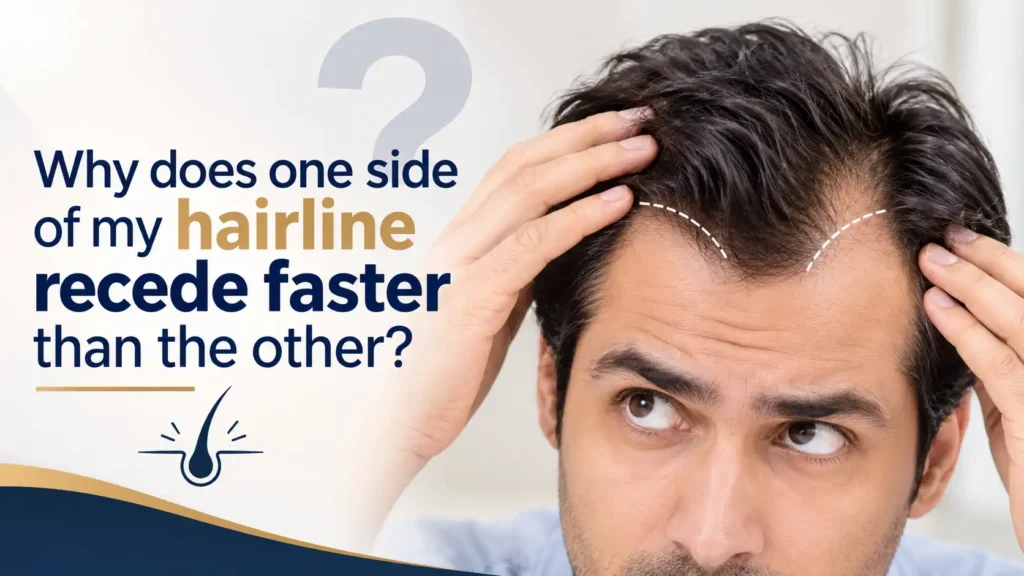
You are combing your hair in the mirror and something looks off. The left temple has pulled back, but the right one still looks almost the same. Or the reverse. It is a very common worry, and it usually brings the same questions: Is something wrong with me? Is it my parting? Is it my pillow? Will the other side follow?
This guide explains the real reasons one side of the hairline can recede faster, which signs mean you should see a doctor sooner rather than later, what you can do about it, and when a hair transplant becomes a sensible option.
Quick Answer: Why Is One Side of My Hairline Receding Faster?
The most common reason is simple: pattern hair loss rarely progresses perfectly evenly. Most faces and scalps are naturally a little asymmetrical, and hair loss follows that asymmetry. But uneven recession can also come from repeated pulling on the hair (traction), scalp conditions, autoimmune or scarring hair disorders, or an old scar. Because some of these causes can cause permanent damage if missed, a one-sided change that is fast, painful or itchy deserves a proper examination.
Is It Normal for a Hairline to Be Uneven?
Yes, to a degree. Many people have a slightly uneven hairline from the start. The two temples, the two sides of the forehead and the way hair grows from the crown are rarely mirror images.
What matters is change over time. A hairline that has always been a little uneven is usually not a concern. A hairline that has visibly shifted on one side over months is worth understanding.
7 Common Reasons One Side Recedes Faster
1. Pattern Hair Loss (Androgenetic Alopecia) That Is Not Symmetrical
Pattern hair loss is the most common cause of a receding hairline in both men and women. It is driven by genetics and hormone sensitivity of the hair follicles, which gradually shrink and produce finer, shorter hair. Follicle sensitivity does not switch on at exactly the same pace on both sides, so one temple can thin earlier or faster than the other. This usually settles into a more even pattern over time, but it can look lopsided for a few years.
2. Traction From Hairstyles, Caps, Helmets and Headgear
Repeated pulling or friction on the same area of the hairline can damage follicles over time. This is called traction alopecia. Common triggers include:
- Tight ponytails, buns, braids or hair extensions
- A turban, hijab pins or head coverings worn tightly for long hours
- Helmets or caps that rub or pull consistently on one side
- Habitually tugging, twisting or pulling the hair on one side
If the pulling stops early, hair may recover. If it continues for years, the loss can become permanent.
3. Scalp Inflammation and Infections
Persistent dandruff, seborrheic dermatitis, folliculitis or a fungal infection of the scalp can cause patchy thinning and itching. These are often uneven, so one side may look worse. They are usually treatable once correctly identified, which is why guessing at home with random oils or shampoos can delay the right care.
4. Autoimmune Hair Loss (Alopecia Areata)
Alopecia areata can cause patchy hair loss, sometimes along the hairline. It is generally sudden rather than gradual, and the skin underneath often looks normal. It needs a doctor’s diagnosis.
5. Scarring Hair Disorders (Warning Sign)
Some conditions, such as frontal fibrosing alopecia and lichen planopilaris, damage the hair follicle itself so that hair does not return. They can cause a hairline that moves back steadily, sometimes with:
- Redness, scaling or small bumps around hair roots
- Itching, burning or tenderness of the scalp
- Thinning or loss of the eyebrows
- Smooth, shiny skin where hair used to be
These conditions are less common than pattern hair loss, but early treatment matters because lost follicles cannot be brought back. If you notice any of these signs, do not wait.
6. An Old Injury, Surgery or Skin Scar
A past burn, cut, surgical scar, sustained pressure or skin condition near the hairline can leave scar tissue where hair does not grow normally. In that case the “recession” may actually be fixed and not progressive.
7. Health, Nutrition and Hormone Factors
Thyroid problems, iron or vitamin deficiencies, hormonal changes, major illness and stress can all affect hair. These more often cause diffuse shedding across the scalp than one-sided recession, but they can make existing pattern hair loss more noticeable. A doctor can decide whether tests are needed.
What About Sleeping Side, Hair Parting and Mobile Phones?
These are common online explanations, but be careful. There is no strong evidence that sleeping on one side, using a phone on one ear or parting hair on one side causes true hair loss. A habitual parting can, however, make one side of the hairline look thinner or more exposed, and constant tight styling is a genuine traction risk. If your parting is the only thing that has changed, try switching it, but do not let this replace a medical check if the recession continues.
Quick Comparison Table: What Might It Be?
|
Possible cause |
What you may notice |
What to do |
|---|---|---|
|
Pattern hair loss |
Gradual thinning at temples, finer hair, family history |
Get an assessment; early treatment works best |
|
Traction |
Loss where hair is pulled, short broken hairs, small bumps |
Reduce tension; see a doctor if loss continues |
|
Scalp infection or dermatitis |
Itching, flakes, redness, patchy thinning |
Medical treatment after diagnosis |
|
Alopecia areata |
Sudden patch, normal-looking skin |
Doctor diagnosis |
|
Scarring alopecia |
Redness, scaling, burning, eyebrow loss, shiny skin |
See a doctor promptly |
|
Old scar or injury |
Fixed area with no hair, no change over time |
Discuss restoration options |
When Should You See a Doctor?
Book an assessment soon if you notice any of these:
- The recession on one side is clearly progressing over weeks or months
- Itching, pain, burning, redness, scaling or pustules around the hairline
- Eyebrow thinning along with hairline loss
- Smooth, shiny skin where hair used to be
- Hair loss that began suddenly or in a distinct patch
- A family history of hair loss and you want to act early
Causes of hair loss cannot be reliably told apart by looking at a mirror or a phone photo. An examination of the scalp, a medical history and, where needed, tests are what separate harmless asymmetry from something that needs urgent treatment.
A Simple 5-Step Self-Check Before Your Appointment
- Take dated photos. Photograph your hairline in the same light, from the front and both sides, once a month.
- Note when it started. Slow changes over years suggest a different cause than sudden changes over weeks.
- List your habits. Tight hairstyles, caps, helmets, hair products, treatments.
- Check for symptoms. Itching, burning, flaking, redness, bumps, eyebrow changes.
- Note family history and health. Hair loss in relatives, thyroid issues, recent illness, new medicines.
These notes help your doctor reach a diagnosis faster.
Treatment Options for Uneven Hairline Recession
The right option depends on the cause, so treatment follows diagnosis, not the other way around.
Non-Surgical Hair Treatment
For early or moderate loss, a doctor may discuss options such as medical therapy, PRP, GFC or hair regrowth therapy to support existing hair and slow further loss. Results vary between people, and these treatments work best when started early. You can read about our full range of hair treatment in Ghaziabad.
Treating the Underlying Cause
If the cause is traction, a scalp infection or a nutritional issue, treating that cause comes first. Changing hairstyles, treating scalp disease or correcting a deficiency may be part of the plan.
Hair Transplant for a Stable Hairline
When hair loss is established, has reasonably stabilised and there is enough healthy donor hair, a hair transplant may be considered. A good surgeon will not try to make your hairline perfectly mirror-symmetrical, because most natural hairlines are not. The aim is a natural-looking hairline that suits your face, with realistic expectations about density and timeline.
Two important points:
- A hair transplant does not stop ongoing hair loss in non-transplanted areas, so a long-term medical plan is often discussed alongside surgery.
- Scarring hair disorders and active scalp disease need to be controlled before any surgery is considered.
For surgical planning, you can consult plastic surgeon Dr. Sukhbir Singh. Learn more about hair transplant in Ghaziabad, or, if you are travelling from the Noida side, see hair transplant in Noida.
What a Consultation at Renaissance Clinic India Looks Like
At Renaissance Clinic India, Jaipuria Mall, Indirapuram, assessment comes before any treatment plan:
- Understanding your concern: history, family pattern, habits, medicines and earlier treatments.
- Scalp and hairline assessment: examining the hairline, scalp skin and donor area.
- Options and realistic results: what each option can and cannot do, along with risks, sessions and cost.
- Plan and follow-up: a clear plan with scheduled review, whether non-surgical or surgical.
Dr. Ashish Chauhan leads non-surgical hair care, and surgical hair restoration is planned with Dr. Sukhbir Singh where it is appropriate.
- Call: 93133 99990 or 0120-4225557
- Address: Gate No. 2, LGF, Jaipuria Mall, Ahinsa Khand 2, Indirapuram, Ghaziabad, Uttar Pradesh – 201014
- Hours: Monday to Saturday, 10:00 AM – 8:00 PM. Sunday by appointment.
Frequently Asked Questions
Why is my hairline receding on only one side?
The most common reason is that pattern hair loss progresses unevenly. Other causes include traction from hairstyles or headgear, scalp conditions, alopecia areata, scarring hair disorders and old scars. A doctor needs to examine your scalp to tell which applies.
Is an uneven receding hairline normal?
Some asymmetry is normal. A hairline that has always been slightly uneven is usually not a concern, but a hairline that changes visibly over months should be assessed.
Will the other side recede too?
If the cause is pattern hair loss, the other side often follows over time, though the pace varies. If the cause is traction or a scalp condition, it may not, provided the cause is treated.
Can sleeping on one side cause hair loss on that side?
There is no strong evidence that sleeping position causes true hair loss. Tight hairstyles, caps and helmets that pull on the hairline are better-established triggers.
Can a tight ponytail or turban cause a receding hairline?
Yes. Repeated tension on the hairline can cause traction alopecia. Early on it may be reversible, but long-term tension can lead to permanent loss.
Which signs mean I should see a doctor urgently?
Progressive one-sided recession along with itching, burning, redness, scaling, shiny skin or eyebrow thinning. Some scarring hair disorders can permanently destroy follicles, so early diagnosis matters.
Can hair grow back on the receded side?
It depends on the cause. Hair affected by traction, infection or some inflammatory conditions may recover when treated early. Where follicles have been lost or scarred, restoration options such as a transplant may be discussed after the condition is controlled.
Can a hair transplant fix an uneven hairline?
It can help rebuild a natural-looking hairline when hair loss is stable and donor hair is sufficient. Results vary, and surgery does not stop ongoing loss in other areas.
Do I need tests for hair loss?
Sometimes. Depending on your history and examination, a doctor may suggest blood tests or a closer scalp examination to look for underlying causes.