
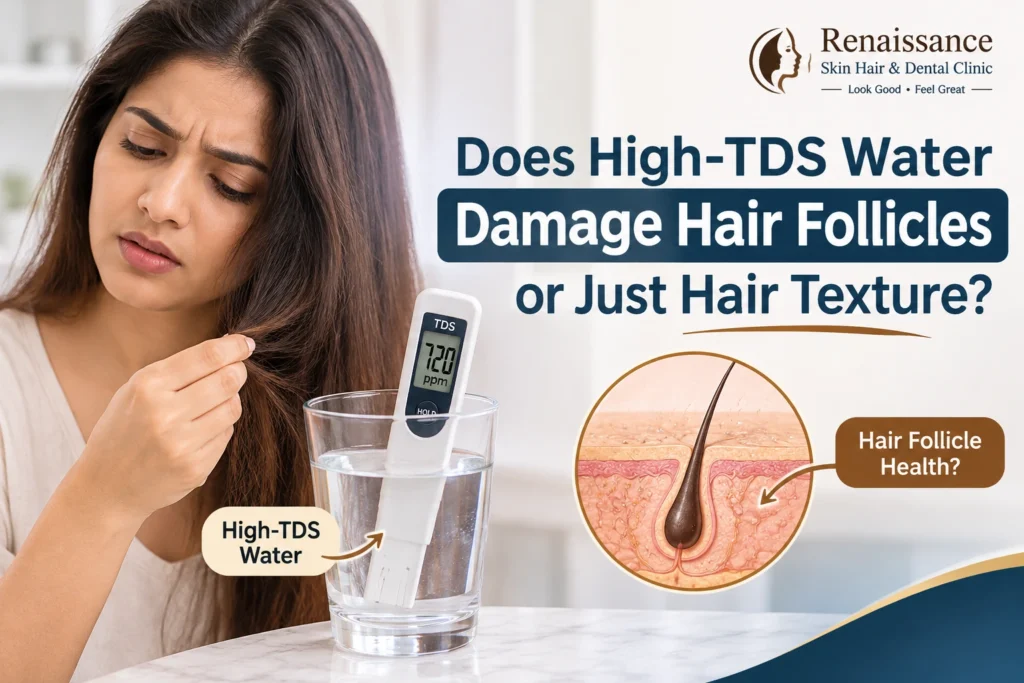
Short answer: does high TDS water damage hair? Yes, but mostly the hair strand, not the follicle. High TDS water leaves minerals on the hair that make it rougher, drier and easier to break. There is no good evidence that it destroys hair follicles, although it can irritate the scalp, and an unhappy scalp is where the follicle question gets more complicated. If you live in Noida or Ghaziabad and see more hair on your comb, this guide helps you tell water damage from true hair loss.
Does High TDS Water Damage Hair? What TDS Actually Means
TDS stands for total dissolved solids: every mineral and salt dissolved in water, measured in mg/L (or ppm). Calcium and magnesium are the part that makes water “hard”, but TDS also counts sodium, chloride, sulphate, bicarbonate and more. In practice, high TDS borewell water in this region is usually hard as well, which is why the two terms get mixed up.
The water in Delhi NCR is a real concern. News reports have described Noida sectors where TDS is often above 1,400 mg/L, a Kaushambi (Ghaziabad) sample that measured about four times the permissible TDS, and some Noida spots reaching 2,500 mg/L. For comparison, Indian drinking-water norms treat about 500 mg/L as the desirable limit.
One detail matters for hair: the RO purifier in your kitchen treats drinking water only. The water in your shower is usually the raw supply, so your hair meets the full mineral load every wash.
Does High TDS Water Damage Hair Strength? What Research Shows
The studies are small and not fully consistent, and almost all of them test hair strands in a lab, not follicles in a living scalp. That limit is important when answering this question.
Study | What was tested | Finding |
|---|---|---|
Hair from 15 women (20 to 25 years), soaked in hard water vs distilled water | No statistical difference in tensile strength or elasticity | |
Hair from 70 men (20 to 30 years), compared with deionized water | Hard-water hair lost strength; the authors link this to more breakage | |
Electron-microscopy study (IJDVL, 2016), as summarised here | Hair washed in hard vs soft water | More magnesium on the strands; visible cuticle damage was not always seen |
Taken together, the fair reading is this: minerals do stick to the hair surface, and some studies find weaker, more breakage-prone hair, while others find no strength change. None of them shows that water reaches the follicle and damages it. The effect is on the shaft: the visible part of the hair that has already grown.
Does High TDS Water Damage Hair Follicles? Why They Are Mostly Shielded
A hair follicle is a small organ sitting a few millimetres below the skin surface, fed by its own blood supply. Water that runs over your scalp for a few minutes does not soak down to it in any meaningful way. Hair loss from the follicle is driven by factors such as genetics, hormones, illness, stress and nutrition, not by the mineral content of bath water.
That said, high TDS water can affect the follicle area indirectly:
- Dry, tight scalp. Mineral film and harsher washing can leave the scalp feeling dry and itchy.
- Dandruff and irritation. Flaking and itching can worsen in hard water, and constant scratching stresses the skin around the follicle.
- Poor shampoo performance. Calcium and magnesium reduce lather, so people often use more product or scrub harder, which adds to the irritation.
A healthy scalp usually recovers once the irritation is treated. If it does not, the real cause is likely something else, which is why a proper scalp examination matters more than blaming the tap.
Hair Breakage vs Hair Fall: How to Tell Water Damage from Real Hair Loss
Most “hair fall” blamed on water is actually breakage. A quick look at the strands you find helps you sort the two.
What you notice | More likely water and texture damage | More likely a follicle or medical cause |
|---|---|---|
Strands in the sink | Short, uneven pieces with no bulb at the root | Full-length hairs with a small white bulb at the root |
Hair feel | Rough, dull, tangled, frizzy, straw-like | Hair feels normal but there is less of it |
Where it shows | Mid-lengths and ends, often after washing | Widening parting, thinner crown, receding temples |
Scalp | Dry or mildly itchy | Often normal, or visibly shiny where hair is lost |
After switching to filtered or softer water | Improves within weeks | No real change |
If your hair is rough but the volume at the scalp is unchanged, water is a reasonable suspect. If the parting is widening or the hairline is moving back, look beyond the water.
Other Causes of Hair Fall in Noida and Ghaziabad
Before changing your shower setup, rule out the common causes that actually act on the follicle:
- Pattern hair loss (genetic). Gradual thinning at the hairline or crown, seen in both men and women.
- Stress, illness or crash dieting. These can push many hairs into the resting phase, with heavy shedding a few months later.
- Low iron, vitamin D or thyroid problems. Simple blood tests can check these.
- Scalp conditions and pollution. Dandruff, scalp infections and heavy styling can weaken hair over time.
Hard water often sits alongside these as a minor contributor, not the main driver. A cause-based plan, such as the one described for hair treatment in Ghaziabad, starts by finding which of these applies to you.
How to Protect Your Hair from High-TDS Water at Home
These steps reduce mineral buildup on the strands and calm the scalp. They will not regrow hair lost for other reasons.
- Filter the water that touches your hair. A shower-head filter or a whole-house softener treats bath water; your kitchen RO does not.
- Use a clarifying shampoo about once every one to two weeks to lift mineral film, then follow with a good conditioner on the lengths.
- Do the final rinse with filtered or softened water if you can, for example from a softened tap or a filtered bucket.
- Be gentle when wet. Detangle with a wide-tooth comb and avoid tight ties, since mineral-coated hair is more fragile.
- Treat dandruff and itch early. A flaky, itchy scalp is the main route by which water can affect the follicle area.
- Limit heat styling and chemical colour, because treated hair absorbs more minerals and shows the damage first.
Give these two to three months. If the shedding continues, the cause is probably not the water.
When to See a Hair Specialist, and What Treatment Can Help
Book a consultation if you notice any of these:
- Heavy shedding that lasts more than about three months
- A widening parting, thinning crown or receding hairline
- Bald patches, or scalp pain, redness or scaling
- No improvement after fixing your water and hair-care routine
A doctor examines your scalp, reviews your history and finds the likely cause first. Depending on what is found, options can include PRP treatment, where platelet-rich plasma prepared from your own blood is placed in the scalp to support weak follicles, or GFC treatment, a growth-factor concentrate also prepared from your own blood and often discussed as an alternative or companion to PRP. The full range is outlined on the hair treatment in Ghaziabad page. Results vary and cannot be guaranteed, and not every treatment suits every person.
Where hair loss is permanent, such as an established bald area or a receded hairline, non-surgical care may not be enough. In that case, you can read about hair transplant in Noida and get a rough idea of fees with the hair transplant cost calculator before you sit down with a surgeon.
Frequently Asked Questions
Does high TDS water damage hair?
Yes, high TDS water damages the hair strand more than the follicle. It mostly causes breakage, dryness and rough texture, and it is not shown to damage the follicle directly. Scalp irritation from hard water can add to shedding, but genetics, stress and nutrition are far more common causes.
Can hard water cause permanent hair loss?
There is no good evidence that it does. Hair damage from mineral buildup is generally reversible once exposure is reduced and the hair and scalp are cared for. Permanent loss usually points to another cause, such as pattern hair loss.
Does an RO purifier protect my hair?
No. A kitchen RO unit treats drinking water only. To protect hair, you need a shower filter or softener on the bathing supply.
How can I tell if it is breakage or real hair fall?
Check the strands. Short, uneven pieces without a root bulb suggest breakage, while full-length hairs with a small white bulb suggest shedding from the root. A widening parting or receding hairline also points to follicle-related loss.
Will changing to soft water regrow my hair?
It can improve texture, softness and breakage within weeks. It will not regrow hair lost to genetic, hormonal or medical causes, which need a doctor’s assessment.
When should I see a hair doctor?
See one if heavy shedding continues for about three months, your parting widens, your hairline recedes, or you have patches or scalp symptoms.
Get Your Scalp Examined at Renaissance Clinic India
If your hair keeps thinning even after you have sorted out your water, the next step is to find the real cause. The team at Renaissance Clinic India offers doctor-led consultations that begin with a proper scalp assessment, not a one-size-fits-all package.
Renaissance Clinic India, Gate No. 2, LGF, Jaipuria Mall, Ahinsa Khand 2, Indirapuram, Ghaziabad, Uttar Pradesh 201014
Call: 93133 99990 or 0120-4225557 · Hours: Mon to Sat 10:00 AM to 8:00 PM, Sunday by appointment
This article is for general information and is not a substitute for medical advice. Results of any hair treatment vary and cannot be guaranteed.