
By Renaissance Clinic India | Published: 2026 | Hair Transplant | Cosmetic Surgery | Ghaziabad
FUE vs FUT hair transplant Ghaziabad — if you are searching for the right hair restoration technique in Delhi NCR, this expert guide will help you decide. Hair loss affects millions across India, and choosing between FUE and FUT is the single most important decision before booking your procedure.
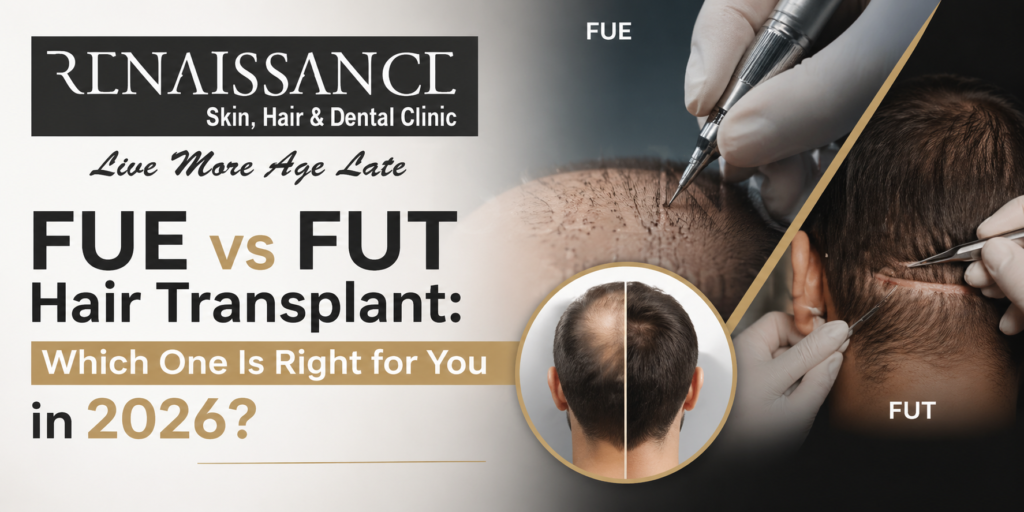
Introduction: The Hair Loss Problem No One Talks About Enough
Hair loss affects millions of men and women across India — and the emotional impact goes far beyond just appearance. Whether it is a receding hairline, a widening parting, or a bald patch at the crown, hair loss often silently erodes confidence, self-image, and even professional presence.
The good news? In 2026, hair transplant technology has advanced to a point where natural, permanent, and virtually undetectable results are possible. But here is the question most patients face before booking their consultation:
“Should I go for FUE or FUT?”
Both are proven, globally-accepted techniques — but they are not the same. Choosing the wrong one for your hair type, loss pattern, or lifestyle can affect your results, recovery, and satisfaction.
In this comprehensive guide, Dr. Sukhbir Singh and the expert team at Renaissance Clinic India, Ghaziabad, break down exactly what FUE and FUT involve, how they differ, who each is best suited for, and what to expect in 2026.
What Is FUE (Follicular Unit Extraction)?
FUE, or Follicular Unit Extraction, is currently the most widely preferred hair transplant technique globally. In this method, individual hair follicles are extracted directly from the donor area — usually the back or sides of the scalp — using a specialised micro-punch tool with a diameter of less than 1mm.
These follicles are then carefully implanted into the balding or thinning areas of the scalp.
Key Features of FUE:
- No linear incision or stitches required
- Leaves tiny dot-like scars that are virtually invisible, even with short hair
- Minimal downtime — most patients return to work within 5–7 days
- Less post-operative discomfort compared to FUT
- Ideal for patients who prefer shorter hairstyles
- Can also be used for beard transplants and eyebrow transplants
| Patient Tip: If you are a working professional or someone who cannot afford a long recovery period, FUE offers the most discreet post-op experience. Most patients at Renaissance Clinic India are back at their desks within a week. |
What Is FUT (Follicular Unit Transplantation)?
FUT, or Follicular Unit Transplantation — also known as the ‘strip method’ — involves removing a thin horizontal strip of scalp from the donor area (usually the back of the head). This strip is then dissected under a microscope by skilled technicians to separate individual follicular units, which are then transplanted into the recipient area.
Key Features of FUT:
- Allows for a higher number of grafts in a single session
- Better suited for patients with advanced hair loss (Norwood scale 5–7)
- The donor area leaves a linear scar that can be concealed with longer hair
- Generally more cost-effective per graft than FUE
- Slightly longer recovery period — typically 10–14 days
- Excellent results for patients who maintain medium to long hair length
| Patient Tip: If you have significant hair loss and need a large number of grafts in one session, FUT may deliver better density outcomes. Your surgeon at Renaissance Clinic India will assess your donor area density before making a recommendation. |
FUE vs FUT: Side-by-Side Comparison
Here is a quick reference table to help you compare the two techniques at a glance:
| Technique | FUE (Follicular Unit Extraction) | FUT (Follicular Unit Transplantation) |
| Procedure | Individual follicles extracted one by one | Strip of scalp removed & dissected |
| Scarring | Tiny dot scars (almost invisible) | Linear scar (can be hidden by hair) |
| Recovery Time | 7–10 days | 10–14 days |
| Pain Level | Minimal | Moderate |
| Hair Density | Moderate graft count | Higher graft count possible |
| Best For | Mild to moderate hair loss | Advanced hair loss (Norwood 5–7) |
| Cost (India) | Higher (per graft) | Comparatively lower |
| Natural Look | Excellent | Excellent |
| Activity Resume | Within 5–7 days | Within 10–14 days |
FUE or FUT — Which Is Better in 2026?
Honest answer: neither technique is universally ‘better.’ The best choice depends entirely on your individual hair loss pattern, scalp condition, donor hair density, lifestyle, and aesthetic goals.
Here is a practical guide to help you decide:
Choose FUE if:
- You prefer very short or shaved hairstyles
- You have mild to moderate hair loss (Norwood 1–4)
- You want the fastest possible recovery
- You are concerned about visible scarring
- You need a beard or eyebrow transplant alongside scalp work
- You are a working professional who cannot take extended leave
Choose FUT if:
- You have advanced hair loss (Norwood 5–7) and need maximum graft coverage
- You are comfortable keeping your hair at medium-to-long length
- You want the most cost-efficient route to high-density results
- You are not concerned about a small, concealable linear scar
- You want the maximum number of grafts in a single session
| Important Note from Our Surgeons: Some patients benefit from a combination of both techniques — using FUT first for maximum coverage and FUE for refining hairlines or filling in gaps. At Renaissance Clinic India, our plastic surgeons create a fully personalised transplant plan based on a detailed scalp analysis during your free consultation. |
Understanding Hair Loss Stages: The Norwood Scale
To make the best decision between FUE and FUT, you first need to understand where you fall on the Norwood-Hamilton Scale — the globally used classification system for male pattern baldness:
- Stage 1–2: Minimal recession. FUE is usually sufficient.
- Stage 3–4: Noticeable thinning at crown or temples. FUE works well; FUT may be considered.
- Stage 5–6: Significant hair loss. FUT or a combined approach is often recommended.
- Stage 7: Extensive baldness. FUT typically offers better donor yield and coverage.
Women experiencing hair loss are assessed differently — the Ludwig Scale is used. Both FUE and FUT can be performed for female patients depending on the pattern and degree of loss.
What to Expect: The Hair Transplant Journey at Renaissance Clinic India
Step 1 — Consultation & Scalp Analysis
Your journey begins with a detailed consultation with our board-certified plastic surgeon, Dr. Sukhbir Singh. Using trichoscopy and digital hair density mapping, we assess your donor area, recipient zone, and overall scalp health to determine the ideal technique and graft count for you.
Step 2 — Pre-Procedure Preparation
Once your personalised plan is ready, our team guides you through pre-op instructions — including medications to avoid, how to prepare your scalp, and what to expect on procedure day. Most patients come in the morning and return home the same evening.
Step 3 — The Procedure (FUE or FUT)
The transplant is performed under local anaesthesia, so you remain comfortable and awake throughout. FUE sessions typically last 6–8 hours for larger graft counts; FUT can be slightly shorter. Our experienced surgical team ensures minimal trauma to follicles for the best survival rate.
Step 4 — Recovery & Hair Growth Timeline
- Days 1–7: Mild swelling and scabbing around grafts — completely normal
- Week 2–4: Transplanted hairs may shed (called ‘shock loss’) — this is expected and temporary
- Months 3–5: New hair growth begins — fine at first, then gradually thickening
- Month 8–12: Full, natural-looking results become visible
- Month 12–18: Final density and texture fully established
| Real Patient Result: One of our patients — a 34-year-old IT professional from Noida with Norwood Stage 4 loss — underwent FUE at Renaissance Clinic India with 2,800 grafts. By month 10, he reported full natural coverage at the crown and a completely restored hairline. His recovery took just 8 days before returning to work. |
How Much Does a Hair Transplant Cost in Ghaziabad in 2026?
Cost is one of the most common questions patients ask — and understandably so. Here is a transparent overview of what to expect at Renaissance Clinic India:
- FUE Hair Transplant: Starting from ₹35,000 (varies by graft count)
- FUT Hair Transplant: Generally 15–20% more cost-effective per graft than FUE
- Combined FUE + FUT: Custom pricing based on individual treatment plan
- Consultation: Free of charge
We believe in complete pricing transparency. There are no hidden charges. During your consultation, you will receive a detailed cost breakdown based on your required graft count and chosen technique.
| Why Choose Renaissance Clinic India? Located at Jaipuria Mall, Indirapuram, we have completed 5,000+ successful procedures across Ghaziabad, Noida, and Delhi NCR. Our team includes a senior plastic surgeon with 15+ years of experience, advanced FUE and FUT infrastructure, and a 4.7-star average rating from 5,500+ patient reviews. |
- When it comes to FUE vs FUT hair transplant Ghaziabad pricing, Renaissance Clinic India offers the most transparent and affordable packages in Delhi NCR — starting from ₹35,000.
Frequently Asked Questions (FAQs)
Q1: Is a hair transplant permanent?
Yes. Transplanted hair follicles are taken from the donor zone — an area genetically resistant to hair loss hormones (DHT). Once transplanted, these follicles continue to grow permanently, just like natural hair.
Q2: Will the results look natural?
Absolutely. At Renaissance Clinic India, we design every hairline to match your facial structure and natural growth direction. Our patients consistently report that no one around them can tell they had a transplant.
Q3: Is there pain during the procedure?
The procedure is performed under local anaesthesia, making it virtually painless during the surgery. Patients may feel mild soreness or tightness for a few days afterward, which is easily managed with prescribed medications.
Q4: Can women get a hair transplant?
Yes. We treat female patients experiencing hair thinning, diffuse loss, or traction alopecia. The approach is customised based on the Ludwig Scale assessment during your consultation.
Q5: How soon can I see results?
Initial growth typically begins around months 3–5. By month 8–10, significant density is visible. Full, final results are usually seen between months 12–18 post-procedure.
Q6: What is the success rate of FUE and FUT?
Both techniques have a graft survival rate of 90–95% when performed by experienced surgeons using proper technique and post-op care. At Renaissance Clinic India, our outcomes consistently meet these international benchmarks.
Conclusion: The Right Choice Is the Informed Choice
FUE and FUT are both excellent, well-established hair transplant techniques — but the right one for you depends on your unique hair loss profile, lifestyle, and goals.
FUE is the ideal choice for most professionals in 2026 — particularly those with mild to moderate hair loss who want minimal scarring and rapid recovery. FUT remains the gold standard for patients needing maximum graft coverage in a single session.
The single best thing you can do before deciding? Book a consultation with an experienced, board-certified surgeon who will examine your scalp in person — not over a photo or a generic website quiz.
Whether you choose FUE or FUT, Renaissance Clinic India is the most trusted destination for hair transplant in Ghaziabad and across Delhi NCR. Book your free consultation today.
| Ready to Take the Next Step? Book your hair transplant consultation at Renaissance Clinic India, Indirapuram, Ghaziabad today. Call us at 093133 99990 or visit renaissanceclinicindia.com. Our team of experts will assess your hair loss, explain your options clearly, and design a plan built around your goals — not a one-size-fits-all package. |