
Written by Dr. Ashish Chauhan, Founder & Director, Aesthetic Physician, Renaissance Clinic India. Hair transplant input from plastic surgeon Dr. Sukhbir Singh.
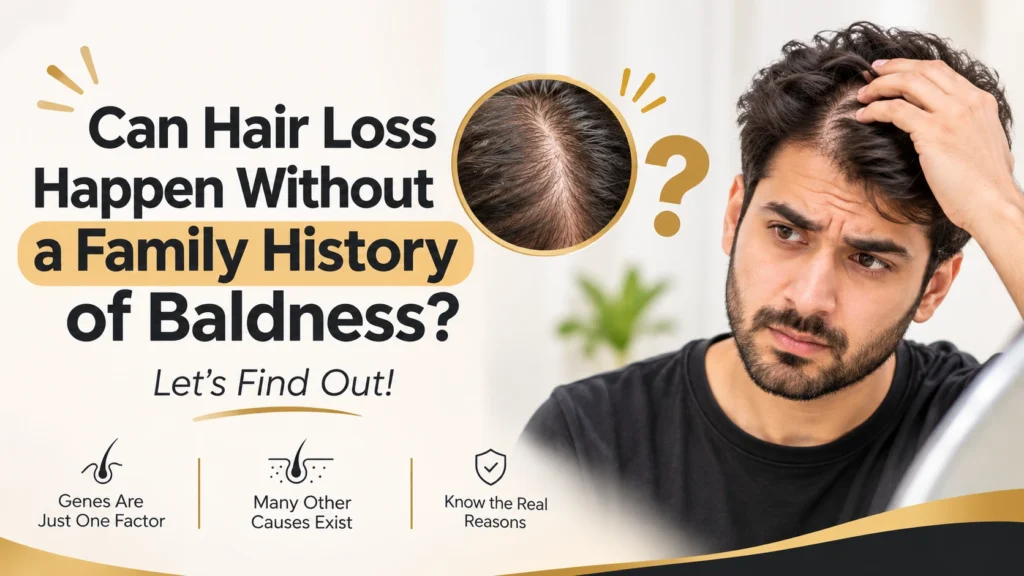
Yes. Hair loss can happen with no family history of baldness, because stress, illness, nutrition gaps, hormone problems, medicines, autoimmune disease and even pattern hair loss itself do not need an obvious family link.
Why a clean family tree does not rule out hair loss
Family history raises your risk but does not decide it. Having a close relative with pattern hair loss does raise the risk, but several genes may contribute, and the way it is inherited is not fully understood because genes and environment appear to interact. There is no single baldness gene passed down by one parent, so an unaffected father or grandfather is no guarantee.
Your family history may be incomplete. Pattern hair loss is common, with more than half of men over 50 showing some degree of it, and many relatives hide it with hairstyles, caps or treatment. If you think nobody in your family lost hair, it is worth asking older relatives on both sides before you rule genetics out.
Many causes have nothing to do with genes. Stress, illness, nutrition gaps, thyroid problems, medicines, scalp infections and autoimmune conditions can all thin hair in people with no family history at all. The next sections explain how to tell them apart, because the cause decides the treatment and whether hair is likely to grow back.
Common causes of hair loss without a family link
Cause | What happens | Usually reversible? |
|---|---|---|
Stress-related shedding (telogen effluvium) | A shock such as surgery, childbirth, high fever, flu, severe anaemia or intense stress pushes many hairs into rest, and heavy shedding follows about 6 weeks to 3 months later | Often yes, once the trigger passes, with regrowth possibly starting around 6 months |
Crash diets and rapid weight loss | Can trigger the same shedding | Often yes, once eating and weight stabilise |
Low iron or protein | Poor intake can trigger shedding | Often yes, with a corrected diet |
Thyroid disease | Too much or too little thyroid hormone disrupts growth, often as diffuse thinning | Usually improves once hormone levels are back to normal |
Medicines | Starting, stopping or switching a medicine can set off shedding | Often yes, and a doctor may adjust the medicine |
Alopecia areata | An autoimmune condition that causes patchy or total loss, which stress or illness may trigger | Variable, but the follicles are usually preserved, so regrowth is possible |
Scalp conditions | Ringworm (fungal infection), seborrhoeic dermatitis and psoriasis can all thin hair | Usually, once the scalp condition is treated |
These points follow a medical review of hidden causes of hair loss, a clinic guide to thyroid-related hair loss, and a clinical review noting that the follicles are preserved in nonscarring alopecias, so regrowth is possible. Never stop a prescribed medicine on your own because of hair loss. Speak to the doctor who prescribed it.
Hidden contributors worth checking
- Thyroid. Both an overactive and an underactive thyroid can make hair stop growing or shed more. The loss is often diffuse thinning rather than bald spots, and it can reach the eyebrows and eyelashes. Autoimmune thyroid disease may also raise the risk of alopecia areata.
- Iron and protein. Low intake of either can trigger shedding, and improving the diet can help.
- Other nutrients and hormones. Low zinc, biotin or vitamin D, and hormonal conditions such as thyroid disease or PCOS, are also listed among causes of thinning.
- Medicines and treatments. Some medicines can trigger shedding, as can chemotherapy and radiation, which cause sudden, widespread loss.
- Biotin supplements. Evidence that biotin helps hair is limited. If you take it, stop at least 72 hours before blood tests, because it can skew lab results.
A balanced diet with enough iron, protein, zinc and vitamin D, plus ways to manage stress, supports recovery. Test results should decide whether you need supplements, not guesswork.
Patterns that point away from inherited baldness
The way hair is lost often hints at the cause. None of these is a diagnosis, and you can have inherited and trigger-driven loss at the same time.
- Heavy shedding that starts weeks or months after an event. Illness, surgery, childbirth, a high fever or a crash diet suggests stress-related shedding.
- Round, smooth bald patches. This pattern points towards alopecia areata.
- Thinning evenly across the scalp. With no clear hairline or crown pattern, a trigger such as a thyroid problem or low iron is possible.
- Thinner eyebrows or eyelashes as well. This can point towards a thyroid or autoimmune cause.
- Itching, scaling, redness or pain on the scalp. A scalp condition is likely.
- Hair loss that began after starting or stopping a medicine. Tell your doctor, who may adjust it.
By contrast, a slowly widening parting, receding temples or a thinning crown over years is the classic look of pattern hair loss, which can appear even when no relative is obviously affected.
What a doctor checks to find the cause
Finding the reason comes before any treatment, because treating the wrong cause can waste months. A good assessment usually includes:
- Your history. When the loss began, how fast it is moving, illnesses, surgery, childbirth or stress in the last few months, diet and weight changes, medicines, periods, and family history on both sides.
- A scalp examination. The doctor looks at the pattern of loss, the scalp skin and the thickness of your hair.
- Blood tests where needed. Blood tests can confirm a thyroid problem, and a doctor may also check iron and other levels.
- A scalp biopsy in unclear cases. A small sample can help confirm inherited hair loss when the picture is not clear.
At Renaissance Clinic India, hair treatment in Ghaziabad starts the same way, with a scalp examination and a discussion of how long and how much hair you are losing, the likely causes such as genetics, stress, diet, scalp or hormones, and which treatment suits your stage.
What can help once the cause is known
If the cause is a thyroid problem, low iron or a medicine, correcting that comes first, and your doctor may then add treatments that support the follicles. Dr. Ashish Chauhan, an aesthetic physician, leads the clinic’s non-surgical hair care, and options are chosen after examination.
Option | What it is | Usually discussed for |
|---|---|---|
A cause-based programme for thinning and excess shedding in men and women | Finding and treating the reason first | |
Platelet-rich plasma from your own blood, placed in the scalp to support weak follicles | Early thinning, weak hair | |
Growth factor concentrate from your own blood, often an alternative or companion to PRP | Thinning where follicles are still active | |
Controlled micro-channels that stimulate the scalp and may help treatments absorb | Thinning areas with living follicles | |
Nutrient-rich injectable mixes delivered to the scalp to nourish hair roots | Dull, thin hair | |
Non-surgical care aimed at slowing loss and encouraging healthier growth | Ongoing thinning |
Hair grows slowly, so visible change usually takes a few months, and maintenance may be needed. Stress-related shedding often settles on its own once the trigger passes, so a good doctor will tell you honestly when watching and waiting is enough. Results vary from person to person and cannot be guaranteed.
When does a hair transplant make sense?
A transplant is not the answer to temporary hair loss. If stress, illness, thyroid disease or a medicine caused your shedding, the first step is to treat the cause and give hair time to recover. A transplant is considered when loss is permanent, such as long-standing pattern hair loss with visible bald areas, a receding hairline or a thin crown, and you still have enough donor hair. It moves healthy follicles from a donor area into the thinning zone, and the surgeon decides whether FUE or another technique suits you.
Pattern hair loss can start even when no relative is obviously affected, so having no family history does not rule out pattern hair loss. What matters is the cause, the stage and your donor hair, all of which are judged at examination.
At Renaissance Clinic India, plastic and cosmetic surgeon Dr. Sukhbir Singh advises whether your hair loss needs a transplant or can be managed without surgery. You can read about the procedure on the hair transplant in Ghaziabad page. If you live in Noida or Greater Noida, the clinic is a short drive away, and the hair transplant in Noida page covers cost, surgeon and results for patients coming from there.
When should you see a doctor?
Book a scalp assessment if any of these apply:
- You are losing hair heavily and suddenly, with no clear reason.
- You see round, smooth bald patches.
- Your scalp is red, scaly, itchy or painful.
- Heavy shedding has lasted more than about six months.
- Hair loss comes with tiredness, weight change, feeling cold or hot, or irregular periods.
- The loss began after you started, stopped or changed a medicine.
- Your parting is widening or your hairline is receding, even though nobody in your family has lost hair.
Seeing someone early keeps more options open, because treatment works best while follicles are still active.
Frequently asked questions
Can hair loss happen without a family history of baldness?
Yes. Stress, illness, nutrition gaps, thyroid problems, medicines, scalp conditions and autoimmune disease can all cause hair loss, and pattern hair loss can also appear when no relative is obviously affected.
Can I get pattern baldness if neither parent is bald?
It is possible. Several genes appear to be involved, and your family history may be incomplete or hidden by hairstyles and treatment. A scalp examination shows whether your thinning follows a pattern.
What causes sudden hair loss with no family history?
The most common cause is stress-related shedding, set off by surgery, childbirth, high fever, illness, crash dieting or intense stress. Heavy shedding usually starts 6 weeks to 3 months after the trigger and often settles once it passes.
Is hair loss without a family history reversible?
Often, yes, when the cause is temporary or treatable, such as stress, low iron or a thyroid problem. Pattern hair loss can be slowed and sometimes improved. Results vary and cannot be guaranteed.
Can thyroid problems cause hair loss?
Yes. Both an overactive and an underactive thyroid can cause hair to shed more, often as diffuse thinning. It usually improves once thyroid hormone levels are back to normal.
Which tests are done for hair loss?
A doctor takes your history and examines your scalp. Blood tests, such as thyroid and iron levels, are used where needed, and a scalp biopsy may help in unclear cases.
Where can I get my hair checked in Ghaziabad or Noida?
Renaissance Clinic India is at Gate No. 2, LGF, Jaipuria Mall, Indirapuram, Ghaziabad. It is not inside Noida, but many patients from Noida and Greater Noida visit for consultation. Call 93133 99990 to book.
About the author and surgeon
Dr. Ashish Chauhan is an aesthetic physician and skin specialist, and the founder and director of Renaissance Clinic India. He leads the clinic’s non-surgical hair care, including PRP, GFC and microneedling, and previously worked at Ram Manohar Lohia Hospital, New Delhi.
Dr. Sukhbir Singh is the clinic’s Senior Consultant and plastic and cosmetic surgeon. His qualifications include MBBS, MS in General Surgery, DNB in Plastic Surgery and a fellowship in cosmetic surgery, with 18+ years of experience. He is a full member of the Association of Hair Restoration Surgeons – India, and he advises when hair loss needs a transplant.
Book a scalp assessment at Renaissance Clinic India
If you are losing hair and cannot find a reason in your family, a scalp examination is the first step towards an answer. Renaissance Clinic India offers doctor-led consultations for hair fall and thinning, with a clear plan, timeline and estimate explained before you decide. You can also read about Dr. Ashish Chauhan and the clinic’s hair treatment in Ghaziabad before you visit.
- Address: Gate No. 2, LGF, Jaipuria Mall, Ahinsa Khand 2, Indirapuram, Ghaziabad, Uttar Pradesh 201014
- Phone: 93133 99990 or 0120-4225557
- Hours: Monday to Saturday, 10:00 AM to 8:00 PM. Sunday by appointment, so please call ahead.
- Book online: Request a consultation
This article is general information and not medical advice. Results vary from person to person and cannot be guaranteed. Suitability for any treatment can only be decided after an in-person consultation.