
Is Hair Transplant Safe for Everyone? A Complete Guide
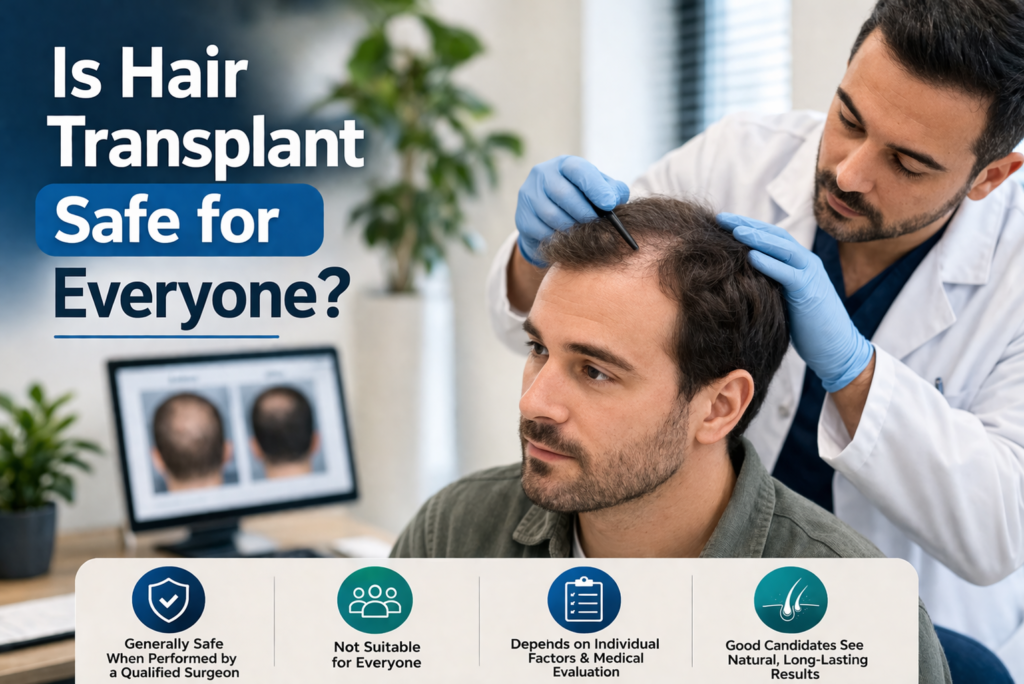
Expert Medical Guide •
Updated 2025 • Hair Transplant | FUE | FUT | Skin Treatments
| FAQs
6,000 Max Grafts per Session | 98.6% Graft Growth Rate | 90% Patients Re-Book | 100% Free Replacement Guarantee |
Hair loss affects millions of
Indians across Delhi NCR, Ghaziabad, Noida, and beyond — and the question we
hear most at Renaissance Clinic India is: “Is hair transplant really safe for
me?” The honest answer is nuanced, and this complete guide will walk you
through everything — from how the procedure works to who the ideal candidates
are, what risks exist, and how our expert team at Jaipuria Mall, Indrapuram
ensures your safety every step of the way.
CLINIC LOCATION Renaissance |
1. What Is a Hair Transplant?
A hair transplant is a minimally
invasive surgical procedure in which healthy hair follicles are harvested from
a donor area (usually the back or sides of the scalp) and transplanted to a
recipient area experiencing thinning or baldness. Unlike topical solutions or
medications, a hair transplant delivers permanent, natural-looking results
because it uses your own living hair follicles.
At Renaissance Clinic India, we
perform both FUE (Follicular Unit Extraction) and FUT (Follicular Unit
Transplantation), including our signature Mammoth Session — transplanting up to
6,000 grafts in a single day, far exceeding the 2,000–2,500 graft ceiling
common in most Indian clinics.
FUE vs FUT — Comparison
Feature | FUE | FUT |
Scarring | Tiny dot | Linear scar |
Recovery Time | 5–7 days | 10–14 days |
Grafts / | 2,000–4,000 | Up to 6,000 |
Best For | Early–moderate | Advanced |
Pain Level | Minimal | Minimal |
Natural | Excellent | Excellent |
2. Is Hair Transplant Safe? The
Medical Truth
When performed by qualified
cosmetic surgeons in a well-equipped, sterile clinic, hair transplant is
considered a very safe procedure with an extremely low risk profile. It is
performed under local anaesthesia, meaning you are awake throughout but feel no
pain. There is no general anaesthesia, no overnight hospital stay, and — at
Renaissance Clinic India — no compromise on hygiene or technique.
Key Safety Factors
✓ Performed by qualified medical practitioners with
cosmetic surgery specialisation
✓ Sterile OT environment with up-to-date, regularly
sanitised equipment
✓ Individualised pre-procedure health screening for every
patient
✓ Advanced local anaesthesia protocols to eliminate
discomfort
✓ Post-operative aftercare packages tailored specifically
to each patient
✓ Free graft replacement if growth rate falls below 90%
(Renaissance Clinic guarantee)
WHY LOCAL ANAESTHESIA MAKES IT Because hair |
3. Who Is a Good Candidate?
Hair transplant is appropriate for
a wide range of patients, but a thorough consultation — offered free of charge
at Renaissance Clinic India — is essential before any procedure. The ideal
candidate generally:
✓ Is between 25–65 years of age with stable pattern
baldness (Norwood Scale III–VII)
✓ Has an adequate, healthy donor area with dense hair
follicles
✓ Has realistic expectations about the outcome and recovery
timeline
✓ Is in generally good health with no uncontrolled systemic
illness
✓ Is a non-smoker or willing to quit for the recovery
period
✓ Has experienced hair loss due to androgenetic alopecia
(male/female pattern baldness)
✓ Has hair loss from scarring (post-burns, surgeries)
stable for 12+ months
Who May Not Be a Suitable Candidate?
Not everyone is suitable for hair
transplant surgery, and our surgeons prioritise your safety above everything
else. You may require further evaluation if you:
✗ Have uncontrolled diabetes, hypertension, or clotting
disorders
✗ Are on blood thinners (e.g. warfarin, aspirin) without
medical clearance
✗ Have active scalp infections, psoriasis, or dermatitis in
the treatment area
✗ Are under 22 and still experiencing active, progressive
hair loss
✗ Have diffuse unpatterned alopecia (DUPA) with
insufficient donor density
✗ Have had recent chemotherapy or are currently undergoing
cancer treatment
✗ Suffer from trichotillomania or other psychological
hair-pulling conditions (without treatment)
IMPORTANT NOTE Being on this |
4. The Procedure: Step by Step
Understanding exactly what happens
on the day of your hair transplant can significantly reduce anxiety. Here is
what to expect at Renaissance Clinic India:
Step 1 — Free Consultation Full
hair loss assessment, scalp analysis, medical history review, and personalised
treatment plan creation.
Step 2 — Pre-Op
Preparation Blood tests, scalp photographs, marking of the recipient
hairline, and donor area preparation on the day of surgery.
Step 3 — Local Anaesthesia Both
donor and recipient areas are numbed. You remain awake, comfortable, and
relaxed throughout.
Step 4 — Graft Extraction Individual
follicular units are harvested one by one (FUE) or as a strip (FUT) from the
donor area.
Step 5 — Graft Preparation Extracted
follicles are carefully sorted, trimmed, and preserved in a specialised
solution to maximise viability.
Step 6 — Implantation Follicles
are placed at precise angles and depths to replicate natural hair growth
patterns and density.
Step 7 — Post-Op Care Detailed
written and verbal aftercare instructions, follow-up appointments, and direct
surgeon contact for any concerns.
Step 8 — Results Initial
growth begins at 3–4 months; full results visible at 12–18 months. 90–100%
growth rate achieved in 98.6% of patients.
5. Risks & How We Mitigate Them
All surgical procedures carry some
risk, and we believe in complete transparency with our patients. Hair
transplant at a qualified clinic carries a very low risk profile:
Risk | Likelihood | How We |
Temporary | Common, | Anti-inflammatory |
Shock loss | Common, hair | Patient |
Infection | Rare (<1%) | Sterile |
Scarring | Minimal (FUE: | Precision |
Unnatural | Rare at | Experienced |
Graft failure | Rare (1.4% of | Free |
6. Skin Treatments at Renaissance
Clinic India
Beyond hair restoration,
Renaissance Clinic India is a full-service cosmetic clinic offering dermatology
and skin care treatments that complement and support hair transplant results.
Healthy skin is the foundation of successful hair growth, and our dermatologists
work closely with transplant surgeons for integrated care.
- Dermal Fillers: Restore
volume and contour to the face with hyaluronic acid-based fillers tailored to
your features. https://renaissanceclinicindia.com/dermal-fillers - Laser Hair Removal: Permanent
reduction of unwanted body and facial hair using advanced laser
technology. https://renaissanceclinicindia.com/laser-hair-removal - Skin Rejuvenation (PRP /
Peels): PRP, chemical peels, and micro-needling to restore
youthful, glowing skin. https://renaissanceclinicindia.com/skin-rejuvenation - Acne Scar Treatment: Multi-modal
scar reduction achieving 70–80% improvement, tailored for brides, grooms, and
professionals. https://renaissanceclinicindia.com/acne-scar-treatment - Tattoo Removal: Safe,
effective Q-switched laser tattoo removal with minimal downtime. https://renaissanceclinicindia.com/tattoo-removal - Botox / Anti-Ageing: Precision
Botox injections to soften lines, lift brows, and restore a refreshed, natural
appearance. https://renaissanceclinicindia.com/botox - Stretch Mark Removal: Fractional
laser and micro-needling to significantly reduce stretch marks on abdomen,
thighs, and arms. https://renaissanceclinicindia.com/stretch-marks-removal - Cosmetic Surgery: Facial
surgery, rhinoplasty, breast surgery performed by hand-picked, highly qualified
surgeons. https://renaissanceclinicindia.com/cosmetic-surgery
7. Why Indrapuram, Ghaziabad Is the
Smart Choice
Located strategically at Jaipuria
Mall, Ahinsha Khand 1, Indrapuram, Ghaziabad – 201014, Renaissance Clinic India
is easily accessible from across the Delhi NCR region. The
Indrapuram–Indirapuram corridor is one of the fastest-growing residential and
commercial hubs in the NCR, housing a large, educated population that
increasingly demands world-class medical and cosmetic care.
Areas We Serve:
- Indrapuram / Indirapuram: https://renaissanceclinicindia.com/hair-transplant-indrapuram
- Vaishali & Vasundhara: https://renaissanceclinicindia.com/hair-transplant-vaishali
- Noida & Greater Noida: https://renaissanceclinicindia.com/hair-transplant-noida
- East Delhi & Delhi NCR: https://renaissanceclinicindia.com/hair-transplant-delhi
- Kaushambi & Crossing Republik:https://renaissanceclinicindia.com/hair-transplant/
- Raj Nagar Extension & Sahibabad: https://renaissanceclinicindia.com/hair-transplant-raj-nagar-extension
LOCAL ADVANTAGE Choosing a |
8. Post-Transplant Care & Skin
Health
The 12–18 months following your
hair transplant are just as important as the procedure itself. At Renaissance
Clinic India, every patient receives a bespoke aftercare package — not a
generic checklist.
Week 1–2: Immediate Post-Op
Avoid direct sunlight, strenuous
exercise, and swimming. Gentle washing with a prescribed shampoo begins on Day
3. Expect mild redness, crusting, and sensitivity — all normal and temporary.
The clinic team is available for any queries.
Month 1–3: The Patience Phase
Transplanted hairs will shed —
this is called shock loss and is entirely normal. The follicles are alive
beneath the scalp and will begin producing new hair from Month 3. Scalp care
and sun protection are paramount during this phase.
Month 4–12: Visible Growth
New hair begins to emerge and
thickens progressively. Our dermatology team may recommend PRP (Platelet-Rich
Plasma) therapy or scalp rejuvenation treatments to accelerate and enhance
growth.
Month 12–18: Final Results
Full density is visible. Most
patients achieve 90–100% graft survival. If your growth falls below 90%,
Renaissance Clinic India replaces the grafts at no additional cost.
9. Explore More at Renaissance
Clinic India
Visit the following pages on our
website for detailed information on every treatment:
- Hair Transplant Overview —
https://renaissanceclinicindia.com/hair-transplant - FUE Hair Transplant —
https://renaissanceclinicindia.com/fue-hair-transplant - FUT / Strip Method —
https://renaissanceclinicindia.com/fut-hair-transplant - Mammoth Session (6000 Grafts) —
https://renaissanceclinicindia.com/mammoth-session - Skin Treatments —
https://renaissanceclinicindia.com/skin-treatments - Acne Scar Treatment —
https://renaissanceclinicindia.com/acne-scar-treatment - Laser Hair Removal —
https://renaissanceclinicindia.com/laser-hair-removal - PRP
Therapy — https://renaissanceclinicindia.com/prp-therapy - Dermal Fillers & Botox —
https://renaissanceclinicindia.com/dermal-fillers - Dental
Treatments — https://renaissanceclinicindia.com/dental - Book
Free Consultation — https://renaissanceclinicindia.com/contact
10. Frequently Asked Questions
(FAQs)
Q: Is hair transplant
painful?
Hair transplants are performed
under local anaesthesia, so you will not feel pain during the procedure. Some
mild soreness in the donor area may be felt for 1–3 days after, which is
managed with standard pain relief.
Q: Can women get a hair
transplant?
Yes. Female pattern hair loss is
treated effectively with FUE hair transplant, particularly when the donor area
is dense. Our surgeons also address hairline lowering and temple restoration
for women. A consultation will determine your suitability.
Q: What is the minimum
age for hair transplant?
We generally recommend waiting
until 25 years of age, as hair loss patterns need to stabilise. In select
cases, patients under 25 may be considered after thorough evaluation.
Q: How long do hair
transplant results last?
Transplanted hair follicles are
taken from the DHT-resistant zone at the back of the scalp, making them
permanent for most patients. The results can last a lifetime. You may continue
to lose native (non-transplanted) hair over time, which your doctor will
discuss during consultation.
Q: What is a Mammoth
Session at Renaissance Clinic India?
A Mammoth Session is Renaissance
Clinic’s signature large-volume hair transplant procedure, transplanting
4,000–6,000 grafts in a single day. This is ideal for patients with extensive
baldness who need maximum coverage in one sitting — something very few clinics
in India can offer.
Q: How do I book a
consultation at Renaissance Clinic, Indrapuram?
You can book a free consultation
by visiting renaissanceclinicindia.com, calling our clinic directly, or walking
in to: SA35 LGF, Near SRS Box Office, Jaipuria Mall, Ahinsha Khand 1,
Indrapuram, Ghaziabad – 201014.
Q: Does hair transplant
affect skin health?
When performed correctly, a hair
transplant has minimal impact on surrounding skin. Temporary redness and
sensitivity are common. Our integrated skin and hair care team provides
specific skincare protocols to keep your scalp and surrounding skin healthy during
recovery.
ABOUT THE AUTHORS — This article |
Disclaimer: This article is for
informational purposes only and does not constitute medical advice. Please
consult a qualified medical professional for personalised guidance.