
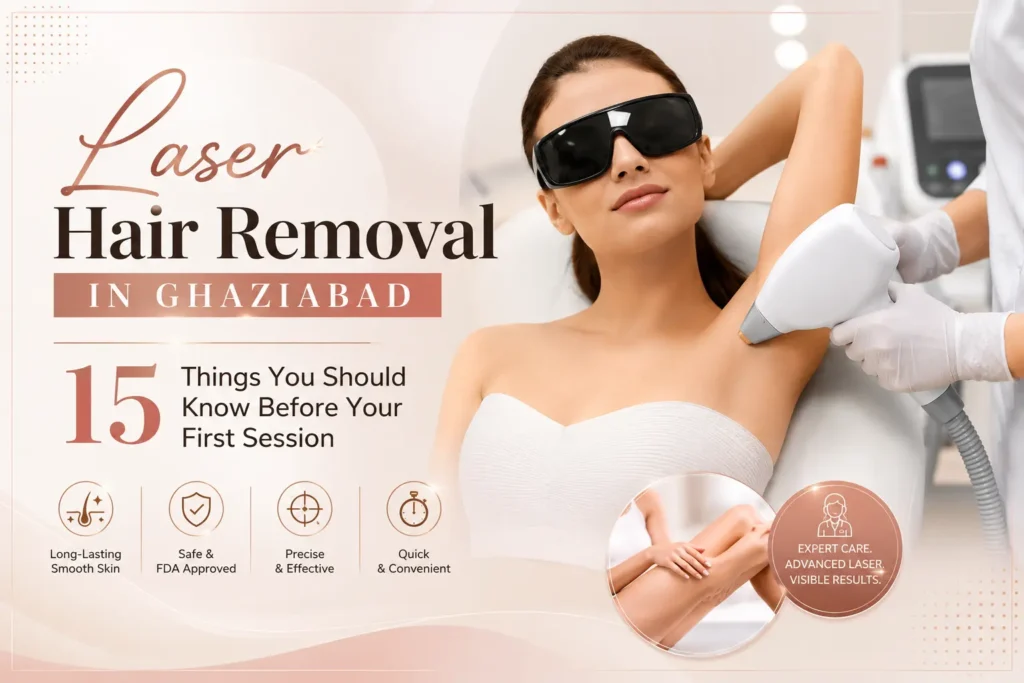
If you’re tired of the endless cycle of shaving, waxing, and threading — and the razor bumps, ingrown hairs, and stubble that come with it — you’ve probably already started researching laser hair removal in Ghaziabad. It’s one of the most requested treatments at aesthetic clinics across Delhi NCR right now, and for good reason: it’s fast, it’s backed by real science, and it delivers results that last far longer than any at-home method ever could.
But before you book your first session, there’s a lot worth knowing — how the treatment actually works, whether it’s safe for Indian skin tones, how many sessions you’ll realistically need, and what it costs. This guide walks you through all of it in plain language, so you can walk into your consultation feeling informed and confident.
At Renaissance Clinic India in Indirapuram, Ghaziabad, we’ve treated patients from across Noida, Vaishali, Vasundhara, and East Delhi using advanced Nd:YAG and diode laser systems calibrated specifically for darker skin tones. Here’s everything you should know.
1. What is Laser Hair Removal?
Laser hair removal — often called laser hair reduction in clinical settings — is a cosmetic procedure that uses concentrated beams of light to reduce unwanted hair growth. Unlike shaving or waxing, which only remove hair from the surface or root temporarily, laser treatment targets the hair follicle itself, the structure beneath your skin responsible for producing hair.
Over a series of sessions, the laser progressively damages the follicle’s ability to regrow hair, leading to a significant and long-lasting reduction in hair density, thickness, and growth speed. It’s not a single-session miracle — it’s a process — but it’s the closest thing available today to genuinely permanent hair removal.
Importantly, “laser hair reduction” is the more medically accurate term, since results are typically a dramatic, long-term reduction rather than the complete, forever elimination of every single hair. Most reputable clinics, including ours, use this terminology honestly rather than overpromising.
2. How Does Laser Hair Removal Work?
The science behind laser hair removal is called selective photothermolysis. In simple terms: the laser emits a specific wavelength of light that is selectively absorbed by melanin — the pigment found in hair follicles. This absorbed light energy converts to heat, which damages the follicle enough to inhibit future hair growth, while leaving the surrounding skin tissue largely unaffected.
At Renaissance Clinic India, we use diode laser hair removal technology alongside Nd:YAG 1064nm laser systems. This combination matters more than most people realize — different lasers perform differently depending on skin tone and hair type, which is exactly why the right technology choice is so important for Indian skin (more on that below).
One key detail patients are often surprised by: lasers only affect hair that’s in its active growth phase, known as the anagen phase. At any given time, only a portion of your body hair is in this phase — the rest is dormant or shedding. That’s precisely why multiple sessions, spaced weeks apart, are necessary to eventually catch every follicle as it cycles through anagen.
3. Laser Hair Removal vs Waxing & Shaving
It helps to see the comparison side by side:
Shaving cuts hair at the skin’s surface. It’s quick and painless but regrowth appears within a day or two, often feeling coarser due to the blunt cut edge. It also carries the highest risk of nicks, razor burn, and ingrown hairs.
Waxing and threading pull hair out from the root, so regrowth takes longer — typically two to four weeks. But they’re painful, can cause skin irritation and ingrown hairs, and need to be repeated indefinitely for the rest of your life.
Laser hair reduction is fundamentally different because it targets the follicle’s regenerative capacity, not just the visible hair. Instead of temporary removal, it produces a cumulative, long-term reduction in hair growth. After a full course of sessions, many patients no longer need any regular hair removal method at all in the treated area — and any regrowth tends to be finer, sparser, and lighter in colour.
The trade-off is upfront time and cost. Waxing costs less per session but adds up over a lifetime; laser costs more per session but is genuinely investment-grade — you’re paying to stop needing hair removal, not just to postpone it.
4. Benefits of Laser Hair Removal
There’s a reason laser hair reduction has become one of the most popular aesthetic treatments in Ghaziabad and across Delhi NCR:
- The laser targets dark, coarse hair with pinpoint accuracy, leaving surrounding skin untouched — safe even for delicate zones like the upper lip, underarms, and bikini line.
- A single pulse treats a patch of skin in a fraction of a second. Small areas like the upper lip can be completed in under a minute; full legs or the back typically take 20–30 minutes per session.
- Long-lasting results. After completing a recommended course, most patients see 85–95% permanent hair reduction, with any remaining regrowth noticeably finer and lighter.
- Modern systems include integrated cooling technology, making the experience far more tolerable than many people expect.
- Suitability for all skin types, including darker Indian and South Asian skin tones, when the right laser (like Nd:YAG) is used.
- Freedom from ingrown hairs, razor bumps, and folliculitis — common frustrations for people with thick, curly, or coarse hair.
- Cost-effectiveness over time. When you tally up years of waxing appointments, razors, and creams, a full laser course often works out cheaper — and saves considerable time.
5. Who is a Good Candidate?
Laser hair removal works best for certain hair-and-skin combinations, though modern technology has widened who can benefit.
Ideal candidates typically have dark, coarse hair, since the laser relies on melanin contrast to target the follicle. This includes:
- Anyone seeking a long-term solution to unwanted facial or body hair
- Women dealing with hormonal hair growth on the chin, upper lip, or jawline
- People prone to ingrown hairs, razor bumps, or folliculitis
- Men wanting permanent reduction on the chest, back, or beard line
- Anyone simply tired of the time and irritation that comes with regular waxing or shaving
A few considerations are worth discussing at your consultation:
- Very light hair — blonde, grey, or white — and fine vellus (peach fuzz) hair responds poorly to laser energy, regardless of technology used
- Active skin infections, open wounds, or herpes outbreaks in the treatment area need to be resolved first
- Pregnancy is generally a reason to defer treatment until after delivery
- Recently tanned or sun-exposed skin increases risk, so sun avoidance beforehand is important
- Certain photosensitising medications (some antibiotics, retinoids) may need to be paused temporarily
- Patients with active hormonal conditions may need a few additional sessions due to ongoing hair stimulus
A proper consultation and skin assessment will clarify exactly where you fall on this spectrum — this isn’t something to self-diagnose from an article.
6. Which Body Areas Can Be Treated?
One of the appeals of full body laser hair removal is just how versatile the treatment is. Virtually any area with unwanted hair can be treated safely, including:
- Full face (upper lip, chin, cheeks, sideburns)
- Underarms
- Arms (full or half)
- Legs (full or half)
- Bikini line and Brazilian area
- Back
- Chest
- Stomach
Each area is assessed individually before treatment. Hair thickness, follicle depth, skin tone, and growth cycle activity all factor into a customised energy setting for that specific zone — a “one setting fits all” approach simply doesn’t produce safe, effective results. Sensitive areas get extra care and cooling protocols to keep the experience as comfortable as possible.
If you’re interested in multiple zones, most clinics — including ours — offer full-body or combination-area packages, which are considerably more cost-effective than booking areas individually over time.
7. Is Laser Hair Removal Safe?
Yes — when performed by trained professionals using appropriate, medically approved technology, laser hair reduction is a safe, well-established procedure with decades of clinical use behind it.
That said, safety hinges heavily on one factor people often overlook: using the right laser for your skin tone. This is especially critical for Indian and South Asian skin, which tends to fall into the medium-to-dark Fitzpatrick skin type range (III–VI). Lasers not calibrated for this range carry a higher risk of pigmentation changes or burns.
This is why Nd:YAG 1064nm lasers are considered the gold standard for South Asian and Indian skin tones — the longer wavelength bypasses surface melanin in the skin more effectively, reducing the risk of side effects while still efficiently targeting the follicle. At Renaissance Clinic India, our systems are specifically calibrated for these skin tones, and every patient undergoes Fitzpatrick skin typing and a mandatory patch test 48 hours before their first full session, to confirm how their skin responds before any broader treatment begins.
8. Does It Hurt?
This is one of the most common questions we hear, and the honest answer is: it depends on your pain tolerance and the treatment area, but most people find it far more tolerable than they expect.
Patients typically describe the sensation as a mild snapping feeling — similar to a rubber band flicking the skin — or a warm tingling. Areas with thinner skin, like the upper lip or bikini line, tend to be more sensitive than larger areas like the legs or back.
Modern laser systems include built-in dynamic cooling technology that cools the skin surface before, during, and after each pulse, which significantly reduces discomfort compared to older laser generations. Topical numbing cream is also available on request for sensitive areas, if needed.
9. How Many Sessions Are Needed?
This is where realistic expectations matter most. Because lasers only affect hair in its active growth (anagen) phase, and different hairs on your body are in different phases at any given time, no single session can catch every follicle.
Most patients need 6–8 sessions for optimal results, spaced 4–8 weeks apart to align with natural hair growth cycles. The exact number depends on your hair colour and thickness, the treatment area, hormonal factors, and skin type — which is why a personalised session plan is always mapped out during consultation rather than promised generically.
Here’s a realistic timeline of what to expect:
- After Session 1: Treated hairs begin shedding over 1–3 weeks; you’ll notice immediate reduction in treated follicles.
- Sessions 2–4: 30–50% cumulative reduction; regrowth becomes visibly finer, patchier, and lighter.
- Sessions 5–6: 60–80% permanent reduction; most patients reach smooth, near-hairless skin in the treated area.
- Post-course: 85–95% permanent reduction maintained long-term, with an optional annual top-up session for some patients.
10. Pre-Treatment Care
A little preparation goes a long way toward getting safe, effective results:
- Shave, don’t wax. The treatment area should be shaved (not waxed, threaded, or plucked) about 24 hours before your session, since the laser needs hair present at the follicle root, not removed from it.
- Avoid sun exposure and tanning in the weeks leading up to treatment — tanned skin increases the risk of side effects and can affect laser settings.
- Skip photosensitising products or medications where possible, and inform your provider about any retinoids, antibiotics, or similar medications you’re using.
- Come in for your patch test. A small test patch 48 hours before your first full session confirms your skin’s response and validates the settings chosen for you.
- Avoid other hair removal methods — like tweezing or waxing — for at least a few weeks prior, so the follicle is intact for treatment.
11. Aftercare Tips
Post-treatment care is just as important as prep, even though downtime is minimal:
- Expect mild redness or warmth, similar to a light sunburn, for a few hours after treatment. This is completely normal.
- Apply SPF 50+ sunscreen diligently and avoid direct sun exposure on the treated area for at least a couple of weeks.
- Avoid heat exposure — this includes saunas, hot showers, and intense workouts — for 24–48 hours post-session.
- Moisturise gently and use soothing gels or cool packs if recommended by your clinic.
- Resume shaving as needed between sessions — it’s completely fine and doesn’t interfere with results. Just avoid waxing, threading, or plucking, since these remove the very root the laser needs to target next time.
- No real downtime. Most patients return to normal activities, including work, immediately, and exercise after about 24 hours.
12. Possible Side Effects
Laser hair reduction has a strong safety profile, but like any cosmetic procedure, it’s worth understanding the possible (usually mild and temporary) side effects:
- Redness and mild swelling around hair follicles, typically resolving within a few hours to a day
- Temporary sensitivity or warmth in the treated area
- Rarely, temporary pigmentation changes (lightening or darkening), more likely if pre-treatment sun exposure guidelines weren’t followed
- Very rarely, blistering or burns — almost always linked to incorrect laser settings or inadequate skin assessment, which is exactly why choosing an experienced provider with appropriate technology for your skin tone matters so much
Choosing a clinic that performs thorough skin assessments and patch testing — rather than applying one generic setting to every patient — is the single biggest factor in avoiding these risks.
13. Cost Factors
Laser hair removal cost in Ghaziabad varies depending on several factors, so it’s difficult to quote a single number without a consultation. What typically influences pricing includes:
- Treatment area size — a small zone like the upper lip costs considerably less per session than full legs or a full back
- Number of sessions required, which depends on your hair type, hormonal factors, and treatment area
- Technology used — clinics using advanced Nd:YAG and diode systems calibrated for Indian skin may price differently than those using older or less specialised equipment
- Package deals — full-body or combination-area packages are usually more cost-effective than booking single areas repeatedly over time
The most reliable way to understand your actual cost is a personalised consultation, where your treatment areas, hair type, and session plan are assessed directly — rather than relying on generic price lists that don’t account for individual variation.
14. Why Choose Renaissance Clinic India
If you’re comparing clinics for laser hair removal in Ghaziabad, here’s what sets Renaissance Clinic India apart:
- Technology built for Indian skin. We use advanced diode and Nd:YAG 1064nm laser systems specifically calibrated for darker Fitzpatrick skin types (III–VI) — the gold standard for safe, effective treatment on South Asian and Indian skin tones.
- Expert-led care. Our team is led by Dr. Ashish Chauhan, Founder & Director of Renaissance Clinic India and an experienced aesthetic physician and skin specialist, alongside Dr. Sukhbir Singh, a Senior Consultant with over 15 years of experience in cosmetic and laser procedures.
- A structured, safety-first process. Every patient goes through detailed skin and hair assessment, mandatory patch testing, and a personalised treatment plan — not a one-size-fits-all approach.
- Convenient Indirapuram location, easily accessible for patients across Ghaziabad, Noida, Vaishali, Vasundhara, and East Delhi.
- A trusted reputation across Delhi NCR, built on patient satisfaction, transparent communication, and natural, long-lasting results — not just for laser hair reduction, but across our full range of hair, skin, and aesthetic treatments.
If you’re searching for the best laser hair removal clinic in Ghaziabad, we’d encourage you to book a consultation and see the assessment process firsthand before committing to any treatment.
15. Frequently Asked Questions
- Is laser hair removal really permanent?
It’s more accurate to call it a long-term, significant reduction rather than 100% permanent removal. Most patients see an 85–95% reduction after a full course, with any regrowth much finer and lighter.
- How many sessions will I actually need?
Most people need 6–8 sessions, spaced 4–8 weeks apart, though this varies by hair type, area, and hormonal factors.
- Does laser hair removal hurt more than waxing?
Most patients find it considerably more comfortable than waxing, describing it as a mild snapping or warm sensation rather than sharp pain.
- Is it safe for dark or Indian skin tones?
Yes, when the correct laser is used. Nd:YAG 1064nm lasers are specifically designed for and considered the gold standard for medium-to-dark Fitzpatrick skin types (III–VI), which cover most Indian skin tones.
- Can I shave between sessions?
Yes, shaving is fine and even encouraged between sessions. Avoid waxing, threading, or plucking, as these remove the hair root the laser needs to target.
- What’s the difference between laser hair removal and laser hair reduction?
They’re often used interchangeably, but “reduction” is the more clinically accurate term, reflecting a significant, long-term decrease in hair growth rather than complete, permanent elimination of every hair.
- Which areas can be treated with laser?
Almost any area, including the face, underarms, arms, legs, bikini/Brazilian area, back, chest, and stomach.
- How long before I see results?
Many patients notice treated hairs shedding within 1–3 weeks of their first session, with cumulative reduction building over subsequent sessions.
- Is there any downtime after treatment?
None. Mild redness or warmth may last a few hours, but normal activities can resume immediately, and exercise after about 24 hours.
- What should I do before my first session?
Shave the area 24 hours prior (don’t wax or thread), avoid sun exposure and tanning, and attend your mandatory patch test 48 hours beforehand.
- Can pregnant women get laser hair removal?
It’s generally recommended to defer treatment until after delivery, as a precaution.
- Does laser hair removal work on grey or blonde hair?
Unfortunately, very light hair — blonde, grey, or white — and fine vellus hair typically respond poorly to laser treatment, since the laser targets melanin (pigment) in the follicle.
- What does a laser hair removal session actually feel like?
Most describe it as a warm tingling or a light snapping sensation, made more comfortable by built-in cooling technology in modern laser systems.
- How much does laser hair removal cost in Ghaziabad?
Cost depends on treatment area size, number of sessions needed, and technology used. A personalised consultation gives the most accurate pricing for your specific needs.
- Is diode laser hair removal different from Nd:YAG?
Both are effective laser types, but they perform differently depending on skin tone and hair type. Many clinics, including ours, use a combination of both to tailor treatment to each patient.
- Will hair grow back after completing my sessions?
Some fine, sparse regrowth is possible over time, which is why an optional annual top-up session benefits some patients. However, most patients maintain smooth results long-term.
- Can I get laser hair removal if I have ingrown hairs or folliculitis?
Yes — in fact, laser hair reduction is often recommended specifically for patients dealing with recurring ingrown hairs, razor bumps, or folliculitis, since it addresses the follicle directly.
- Is a patch test really necessary?
Yes. A patch test 48 hours before your first session confirms how your specific skin responds to the laser and validates that the chosen settings are both safe and effective for you.
- How long does a session take?
It varies by area — small zones like the upper lip take under a minute, while larger areas like the legs or back typically take 20–30 minutes.
- Where is Renaissance Clinic India located?
We’re located in Indirapuram, Ghaziabad (Gate Number 2, LGF, Jaipuria Mall, near Spencers), serving patients from across Ghaziabad, Noida, Vaishali, Vasundhara, and Delhi NCR.
Ready to Say Goodbye to Waxing and Shaving for Good?
If constant shaving, waxing, and ingrown hairs have become an exhausting routine, it might be time to explore a longer-term solution. At Renaissance Clinic India, our advanced diode and Nd:YAG laser systems are specifically calibrated for Indian skin tones, and every treatment plan starts with a thorough skin assessment and patch test — never guesswork.
Book your consultation today and find out exactly how many sessions, which areas, and what investment makes sense for your skin and goals.
📞 Call now: +91 93133 99990 | 0120-4225557
📍 Visit us: Gate Number 2, LGF, Jaipuria Mall, Ahinsa Khand 2, Indirapuram, Ghaziabad, Uttar Pradesh 201014
🌐 Visit: renaissanceclinicindia.com