
Medically reviewed for Renaissance Clinic India, Indirapuram, Ghaziabad
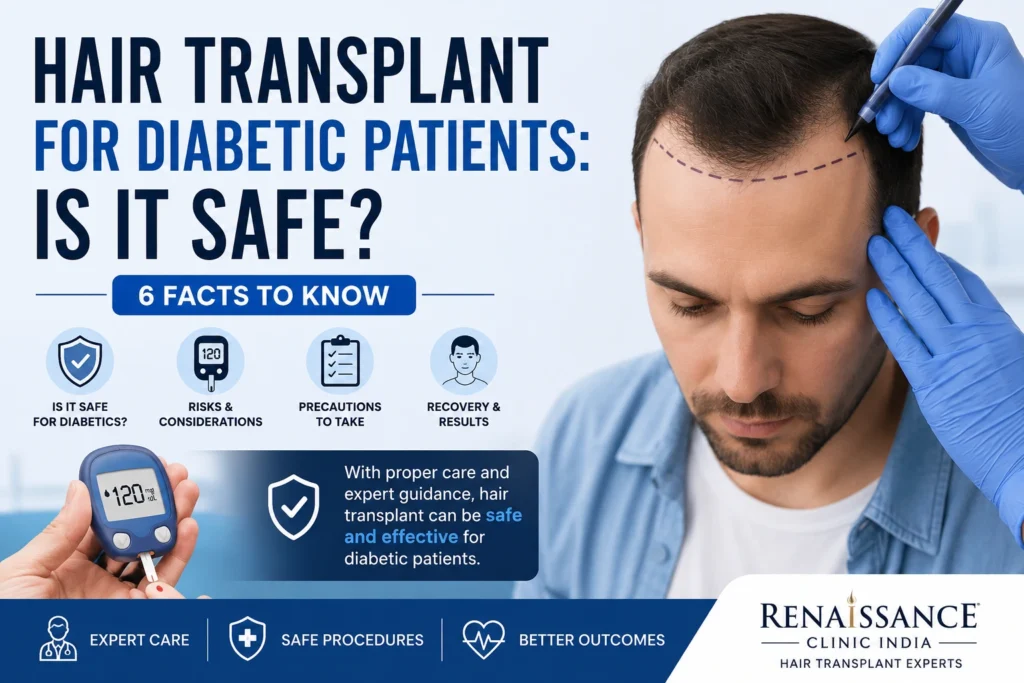
If you’re living with diabetes and thinking about restoring your hairline, you’ve probably wondered whether a hair transplant for diabetic patients is even possible, or whether your blood sugar rules it out entirely. At Renaissance Clinic India, this is one of the first questions our surgeons address during consultation, because the answer isn’t a flat yes or no — it depends almost entirely on how well your diabetes is managed.
This guide walks through what the evidence actually says, the real risks worth understanding, and the precautions that make surgery safe for most diabetic patients.
What You’ll Learn in This Article
- Why Diabetes and Hair Loss Are Often Linked
- Hair Transplant for Diabetic Patients: Is It Actually Safe?
- The Real Risks Diabetic Patients Should Understand
- Why FUE Is Usually Preferred Over FUT for Diabetics
- Well-Controlled vs Poorly-Controlled Diabetes: Who Qualifies
- Pre-Surgery Checklist Before a Hair Transplant
- What Happens During and After the Procedure
- Who Should Not Get a Hair Transplant Right Now
- Recovery Tips for Diabetic Patients
- Common Myths About Diabetes and Hair Transplant
- Final Verdict
- Frequently Asked Questions
Why Diabetes and Hair Loss Are Often Linked
Many people don’t realise that diabetes itself can contribute to hair thinning. Fluctuating blood sugar can reduce circulation to the scalp, disrupt the hair growth cycle, and place stress on the body that pushes more follicles into a resting phase. This is exactly why a growing number of diabetic patients start exploring surgical hair restoration in the first place.
The catch is that the same condition responsible for the hair loss can also complicate the surgery meant to fix it — which is why the safety conversation matters so much before booking a date.
It also explains why diabetic patients often research far more thoroughly than the average patient before choosing a clinic. Understanding exactly how blood sugar interacts with wound healing, and what a responsible surgical team does differently, is the best way to walk into a consultation feeling informed rather than anxious.
Hair Transplant for Diabetic Patients: Is It Actually Safe?
The short answer, confirmed across multiple clinical sources, is that diabetes is not an automatic disqualifier. As one detailed clinical overview puts it, hair transplants are generally safe for people with diabetes, provided their blood sugar is stable and they don’t have severe complications such as advanced neuropathy or vascular disease.
Guidance from surgical practices that specialise in this area typically recommends a recent HbA1c under roughly 8 to 8.5%, with day-of-surgery blood glucose kept in the 100–180 mg/dL range for both type 1 and type 2 diabetics. Outside that range, most surgeons will postpone the procedure until levels are brought under control.
In other words, a hair transplant for diabetic patients is a legitimate, achievable option for the majority of people with diabetes — it simply requires a more thorough pre-surgical work-up than a standard case.
The Real Risks Diabetic Patients Should Understand
Being upfront about risk is part of responsible care. Diabetic patients considering surgery should discuss the following with their surgeon before scheduling anything:
- Delayed wound healing: Reduced blood flow and nerve involvement can slow how quickly incision sites close and recover.
- Higher infection risk: Elevated blood sugar can weaken the body’s ability to fight bacteria at the surgical site.
- Scar complications: Poorly managed sugar levels raise the chance of scars becoming infected or, in rare cases, developing tissue necrosis from insufficient blood supply.
- Lower graft survival: Uncontrolled glucose can reduce how many transplanted follicles successfully take root.
- Longer recovery windows: Even when the surgery goes smoothly, diabetic patients often need extra time and closer follow-up during healing.
None of these risks are automatic — they become significant mainly when diabetes is poorly controlled going into surgery, which is exactly why pre-operative screening matters so much.
Why FUE Is Usually Preferred Over FUT for Diabetics
Technique choice makes a real difference in outcomes. Follicular Unit Extraction (FUE) involves removing individual follicles through tiny, pinpoint incisions rather than a single linear strip, which is the approach used in FUT.
Because FUE creates smaller wounds, it is widely considered the safer, faster-healing option for patients with diabetes, reducing both scarring and the window during which infection could set in. Most experienced clinics now default to FUE for diabetic patients unless there’s a specific clinical reason to consider another method.
Well-Controlled vs Poorly-Controlled Diabetes: Who Qualifies
Surgeons assess candidacy on a spectrum rather than a simple pass/fail. Here’s how the two ends of that spectrum typically compare:
Factor | Well-Controlled Diabetes | Poorly Controlled Diabetes |
HbA1c level | Generally below 8–8.5% | Above 8.5%, or unmonitored |
Wound healing | Close to normal healing timeline | Significantly delayed, higher infection risk |
Blood flow / neuropathy | No major circulation or nerve issues | Reduced circulation, possible nerve damage |
Surgical candidacy | Usually a suitable candidate with monitoring | Surgery postponed until sugar is stabilised |
If you fall closer to the left column, a hair transplant for diabetic patients is usually straightforward with standard precautions. If you fall closer to the right, your surgeon will likely recommend stabilising your sugar levels first and revisiting surgery afterward.
Pre-Surgery Checklist Before a Hair Transplant
Good outcomes start well before the procedure date. Diabetic patients preparing for surgery should typically work through the following steps with both their endocrinologist and their hair transplant surgeon:
- Get a recent HbA1c test. This gives your surgeon a clear picture of your average blood sugar control over the past 2–3 months.
- Review all current medications. Insulin doses and oral medications may need timing adjustments around the day of surgery.
- Share your full medical history. Mention any history of neuropathy, vascular disease, or slow-healing wounds.
- Plan your fasting schedule carefully. Diabetic patients often need a modified fasting protocol to avoid dangerous sugar dips before anaesthesia.
- Arrange post-operative monitoring. Confirm how you’ll track your glucose in the days immediately after the procedure.
- Get medical clearance in writing. Many clinics require a formal sign-off from your treating physician before confirming the surgery date.
What Happens During and After the Procedure
On the day of surgery, your care team will typically check your blood sugar before starting and monitor it periodically throughout the procedure, adjusting insulin or fluids as needed. The surgical team will also take extra care with sterile technique, given the slightly elevated infection risk in diabetic patients.
Afterward, expect a somewhat more structured aftercare routine than a non-diabetic patient might receive — closer monitoring of the donor and recipient areas, clear instructions on signs of infection to watch for, and more frequent follow-up visits until the surgical sites have fully healed.
Who Should Not Get a Hair Transplant Right Now
Surgery isn’t off the table permanently for anyone, but timing matters. Your surgeon will likely recommend waiting if you currently have:
- Blood sugar that is frequently outside your target range or an HbA1c significantly above 8.5%
- Active skin infections or slow-healing wounds anywhere on the body
- Advanced diabetic neuropathy or peripheral vascular disease
- A recent diabetes-related hospitalisation or unstable insulin regimen
In these situations, the recommendation is almost always to stabilise the underlying condition first, then revisit hair restoration once your numbers are consistently in a safe range.
Recovery Tips for Diabetic Patients
- Monitor blood sugar more frequently than usual for the first two weeks after surgery.
- Keep the scalp clean and follow washing instructions exactly as given, to reduce infection risk.
- Watch for redness, swelling, or discharge around graft sites and report it immediately rather than waiting.
- Avoid smoking and limit alcohol, both of which further slow wound healing.
- Attend every follow-up appointment, even if healing feels like it’s going well.
Common Myths About Diabetes and Hair Transplant
Myth 1: Diabetics can never get a hair transplant
This is one of the most persistent misconceptions we hear in consultations. In reality, diabetes only becomes a barrier when it’s poorly controlled. Most patients with stable blood sugar are cleared for surgery without difficulty.
Myth 2: Insulin users are automatically high-risk
Whether someone is on insulin matters far less than whether their glucose readings are consistently within a safe range. A well-managed insulin-dependent diabetic is often a better candidate than an unmedicated patient with erratic sugar levels.
Myth 3: Results will be worse for diabetic patients
When diabetes is properly controlled before and after surgery, graft survival and final density are generally comparable to non-diabetic outcomes. The difference lies mainly in the pace of recovery, not the end result.
Myth 4: A hair transplant will worsen diabetes
A well-planned, properly monitored procedure does not have a lasting effect on long-term blood sugar control. Short-term fluctuations around the day of surgery are managed by your medical team and typically settle within a few days.
Final Verdict
For the majority of people, a hair transplant for diabetic patients is a safe and realistic option — the deciding factor isn’t diabetes itself, but how well it’s controlled going into surgery. With a recent HbA1c in a healthy range, stable glucose on the day of the procedure, and a surgeon experienced in treating diabetic patients, outcomes can closely match those seen in non-diabetic patients.
At Renaissance Clinic India, our surgeons, led by Dr. Sukhbir Singh, routinely evaluate diabetic patients for FUE hair transplant and coordinate with your physician to plan a safe, well-timed procedure. If you’re diabetic and considering hair restoration, book a personalised consultation at our Indirapuram, Ghaziabad clinic to find out exactly where you stand.
Frequently Asked Questions
Can Type 1 diabetics get a hair transplant?
Yes. Type 1 diabetes does not rule out surgery when blood sugar is steady and monitored closely, with a plan in place for insulin dosing on the day of the procedure.
What HbA1c level is considered safe for hair transplant surgery?
Most surgeons look for a recent HbA1c below roughly 8 to 8.5%, along with stable day-to-day glucose readings, before confirming a surgery date.
Does recovery take longer for diabetic patients?
Often, yes. Healing can take somewhat longer due to reduced circulation, so diabetic patients are usually given a more detailed aftercare and follow-up schedule.
Is FUE better than FUT for diabetics?
FUE is generally preferred because its smaller, individual incisions heal faster and carry a lower infection risk compared to the linear strip technique used in FUT.
Will a hair transplant affect my blood sugar levels?
Surgery and anaesthesia can cause temporary fluctuations in blood sugar, which is why glucose is monitored before, during, and after the procedure to keep it in a safe range.
Renaissance Clinic India is a trusted hair transplant and cosmetic clinic in Ghaziabad and Indirapuram, offering FUE and FUT procedures with careful medical screening for patients with diabetes and other health conditions. Visit renaissanceclinicindia.com to learn more or book your consultation today.