
Medically reviewed for Renaissance Clinic India, Indirapuram, Ghaziabad
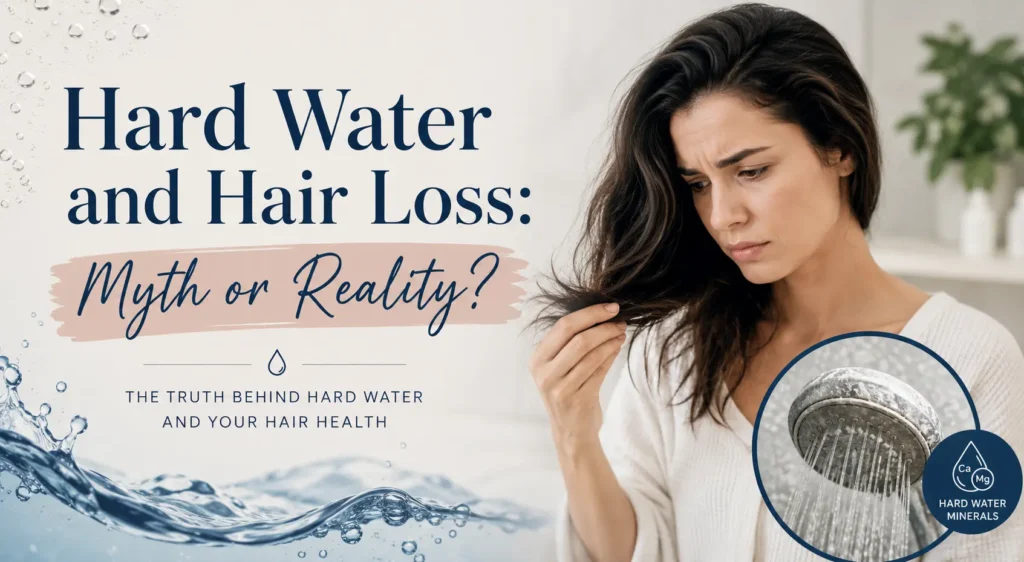
Does hard water cause hair loss? It’s one of the most common questions people ask after noticing increased hair fall, dry hair, or breakage when living in areas with hard water. While hard water does not directly cause permanent hair loss, it can weaken hair strands, increase breakage, and make existing hair problems appear worse. In this article, our hair specialists at Renaissance Clinic India explain the science behind hard water, separate myths from facts, and share expert tips to protect your hair.
In this guide, we’ll walk through what hard water actually does to your scalp and strands, what the research really shows, and how to tell the difference between temporary water-related damage and true, progressive hair loss that needs medical attention.
What You’ll Learn in This Article
- What Is Hard Water, Exactly?
- Hard Water and Hair Loss: What Does the Science Say?
- Why Hard Water Gets Blamed for Hair Loss
- The Real Reality: How Hard Water Damages Your Hair
- Hard Water Damage vs Genuine Hair Loss
- Who Is Most at Risk in Delhi NCR and Ghaziabad?
- 7 Ways to Protect Your Hair From Hard Water
- When to See a Hair Specialist
- Final Verdict: Myth or Reality?
- Frequently Asked Questions
What Is Hard Water, Exactly?
Water is classified as “hard” when it carries a high concentration of dissolved minerals, mainly calcium carbonate and magnesium sulphate. Most homes in Ghaziabad, Noida, and large parts of Delhi NCR depend on groundwater or borewell supply, which tends to run harder than treated municipal water in other regions.
This mineral load is why soap barely lathers, why kettles develop a white crust, and why your skin can feel tight after a shower. Naturally, people start wondering whether the same minerals coating their bathroom fittings are also coating their scalp — and whether that’s behind their thinning hair.
Does Hard Water Cause Hair Loss? What Science Says
This is where things get interesting. A widely cited study published on PMC (National Center for Biotechnology Information) tested hair strands soaked in hard water against strands soaked in distilled water for 30 days. Under normal conditions, researchers found no significant difference in tensile strength between the two groups — but damage became measurable once the water carried a higher mineral or salt load, or when hair was also exposed to heat styling.
A separate 2018 trial published in the International Journal of Trichology went a step further, measuring the actual breaking strength of hair treated with hard water versus deionised water. The hard-water samples were consistently weaker, confirming that repeated exposure does compromise the hair shaft, even if it doesn’t destroy the follicle underneath.
Dermatologists tend to agree on one nuance that often gets lost in salon conversations: hard water cannot reach below the skin to injure the follicle itself. As Healthline reports, hair restoration author Dr. Patrick Angelos notes that hard water-related shedding is more common in people who already have an inflammatory scalp condition such as eczema or psoriasis, rather than being a standalone cause of baldness.
So the honest, evidence-based answer sits in the middle: hard water is not a proven direct cause of permanent hair loss, but it is a proven cause of hair shaft weakness, dryness, and breakage — and in sensitive scalps, it can make existing shedding noticeably worse.
Why Hard Water Gets Blamed for Hair Loss
The confusion is understandable. When someone relocates from a city with soft, treated water to one with mineral-heavy groundwater, they often notice sudden changes — rougher texture, more strands on the pillow, a dull scalp. It’s natural to connect the timing to the new water supply.
But breakage and shedding look almost identical to the naked eye. A strand snapping halfway down its length lands on the floor just like a strand that fell out from the root. Without a closer look, both feel like “hair loss,” even though only one of them involves the follicle.
The Real Reality: How Hard Water Damages Your Hair
Even though hard water rarely destroys follicles directly, it creates a chain of problems that can absolutely make your hair look and feel like it’s falling apart:
- Mineral film build-up: Calcium and magnesium deposit a thin layer on every strand, making hair feel rough, heavy, and difficult to style.
- Blocked moisture and product absorption: That same mineral coating stops conditioners, oils, and serums from penetrating properly, leaving hair chronically dry and brittle.
- Increased friction and breakage: Dry, coated strands snap more easily during combing, tying, or even normal movement.
- Scalp dryness and irritation: Mineral residue can disturb the scalp’s natural oil balance, leading to flaking, itchiness, and low-grade inflammation.
- Weaker future growth cycles: Over months of unmanaged scalp irritation, follicle function can be indirectly affected, contributing to increased shedding on top of breakage.
In short, hard water rarely pulls hair out from the root — but it absolutely wears the hair you already have down to the point where it looks like you’re losing more than you are.
Hard Water Damage vs Genuine Hair Loss: How to Tell the Difference
Because the two issues overlap so much visually, the clearest way to separate them is by pattern, timeline, and how they respond to a change in routine. Here’s a quick side-by-side comparison our specialists use during consultations:
Sign | Hard Water Damage | Genuine Hair Loss |
Where it shows | Mid-shaft breakage, split ends, rough texture | Widening parting, receding hairline, visible scalp |
Feel of hair | Dry, dull, straw-like, tangles easily | Can feel normal, hair simply reduces in density |
Timeline | Appears within weeks of a water change | Develops gradually over months or years |
Response to fixes | Improves with filtered water and deep conditioning | Persists regardless of water quality changes |
If your symptoms match the middle column even after switching to filtered water and gentler products for six to eight weeks, that’s a strong signal to get a professional scalp assessment rather than continuing to experiment on your own.
Who Is Most at Risk in Delhi NCR and Ghaziabad?
Large parts of Ghaziabad and Indirapuram rely on borewell and groundwater supply, which typically carries a higher mineral content than treated surface water. Residents who wash their hair daily, colour or chemically treat their hair, or already have a dry scalp condition tend to notice the effects of hard water fastest.
People with naturally curly or chemically processed hair are also more vulnerable, since their hair cuticle is already more porous and prone to moisture loss. If you fall into any of these groups and have noticed a change in hair texture since moving into the area, hard water is a reasonable first suspect — but it’s still worth ruling out other causes before assuming it’s the whole story.
7 Ways to Protect Your Hair From Hard Water
The good news is that hard water damage is one of the most preventable causes of poor hair quality. Our specialists recommend the following routine to patients dealing with mineral buildup and breakage:
- Install a shower filter. A basic multi-stage filter removes a large share of calcium, magnesium, and chlorine before it ever touches your scalp.
- Use a clarifying or chelating shampoo weekly. This lifts existing mineral deposits without stripping hair on the days in between.
- Try a diluted rinse after shampooing. A mild acidic rinse helps dissolve mineral residue and smooths the hair cuticle.
- Deep condition at least twice a week. This replaces the moisture that mineral film usually blocks from absorbing.
- Wash with lukewarm, not hot, water. Heat opens the cuticle further and worsens mineral penetration and dryness.
- Get your water tested. A simple hardness test tells you exactly how aggressive your filtering routine needs to be.
- Track your shedding for six to eight weeks after making these changes. If breakage improves but shedding from the root continues, book a scalp consultation.
When to See a Hair Specialist
Hard water fixes usually show visible improvement within a few weeks. If you’re still noticing any of the following, it’s time to move past home remedies and get a professional opinion:
- A visibly widening parting or receding hairline
- Clumps of hair falling out from the root, not just breaking mid-strand
- Shedding that continues even after switching to filtered water
- A family history of pattern baldness
- Scalp redness, persistent itching, or visible thinning patches
At Renaissance Clinic India, our team led by Dr. Sukhbir Singh and Dr. Ashish Chauhan offers detailed scalp and hair analysis to identify the real cause of shedding — whether it’s water quality, nutritional deficiency, hormonal change, or genetic pattern hair loss — before recommending a treatment plan that actually fits the diagnosis.
If your hair fall has continued despite a proper hard-water routine, book a consultation with our hair specialists in Indirapuram, Ghaziabad, and get a clear answer instead of another guess.
Final Verdict: Myth or Reality?
The relationship between hard water and hair loss is best described as “partly myth, partly reality.” It’s a myth that hard water alone can make you go bald — the evidence simply doesn’t support that claim. But it’s very much a reality that hard water damages the hair shaft, dries out the scalp, and creates breakage that looks and feels exactly like hair loss.
The takeaway: treat hard water as a hair quality problem you can largely fix at home, and treat any shedding that doesn’t respond to those fixes as a medical question worth answering properly.
Frequently Asked Questions
Can hard water alone cause baldness?
No. Current research does not support hard water as a direct, standalone cause of permanent baldness. It can, however, worsen hair breakage and irritate a sensitive scalp.
How do I know if my hair fall is due to hard water?
If shedding started soon after a change in water source, mostly shows up as breakage rather than root loss, and improves within weeks of filtering your water, hard water is a likely contributor.
Does using RO or filtered water prevent hair fall?
Filtered water reduces mineral buildup and can noticeably improve hair texture and reduce breakage, but it won’t reverse hair loss caused by genetics, hormones, or nutritional deficiencies.
Is hard water hair damage reversible?
In most cases, yes. Once mineral buildup is removed and moisture is restored through the right shampoo, conditioning routine, and filtered water, hair texture typically recovers over a few weeks.
When should I stop blaming hard water and see a doctor?
If you notice a widening parting, visible scalp, or continued shedding after eight weeks of a proper hard-water routine, it’s time for a professional scalp assessment rather than further home experiments.
Renaissance Clinic India is a leading hair transplant and cosmetic clinic in Ghaziabad and Indirapuram, offering FUE and FUT hair transplant, scalp analysis, and advanced skin treatments. Visit renaissanceclinicindia.com to learn more or book your consultation today.