
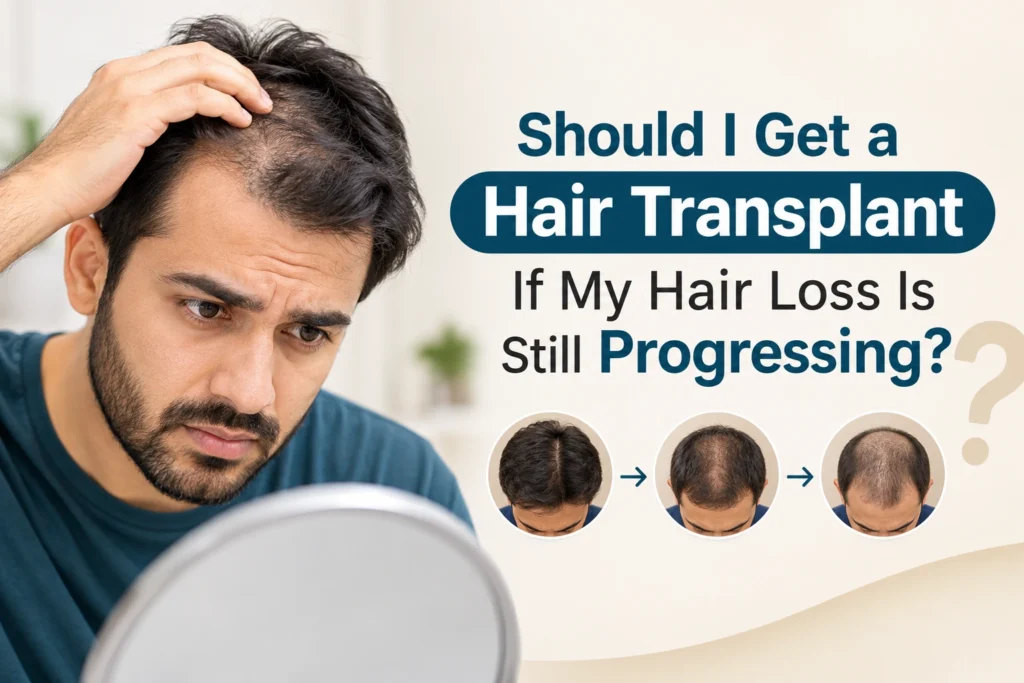
If your hairline is still moving back or your crown is still thinning, it is natural to wonder whether you have missed your moment, or whether it is too early to act. Here is the reassuring truth: yes, you can get a hair transplant even if your hair loss is still progressing, as long as the timing, the design and the long-term plan are right.
At Renaissance Clinic India, this is one of the questions we hear most. This guide explains who can go ahead now, who should wait, and how to protect your results for years to come.
Quick Answer: Is a Hair Transplant Possible With Ongoing Hair Loss?
A hair transplant is possible while hair loss is progressing, because the hair taken from the back and sides of the scalp is naturally resistant to the hormone (DHT) that drives pattern baldness. The real challenge is that your existing hair may keep thinning, so the surgeon must plan a hairline and graft count that still look natural in 5 to 10 years. For many people, a combination of a well-planned transplant and doctor-guided medical treatment gives the most reliable result.
Why Does Hair Loss Keep Progressing?
Most progressive hair loss is androgenetic alopecia, also known as male or female pattern hair loss. It is genetic, and it develops gradually. Sensitive follicles shrink over time and produce thinner, shorter hairs, until some stop producing visible hair at all. A published evidence-based review of androgenetic alopecia treatment describes it as a chronic, progressive condition and identifies oral finasteride (for men) and topical minoxidil as the best-supported medical options.
The important takeaway: because the condition is ongoing, a one-time fix without a plan can leave you with patchy results later. A plan is what makes a transplant last.
When Can You Go Ahead With a Hair Transplant Now?
You may be a good candidate for a hair transplant even with ongoing loss if:
- Your pattern is clear, such as a receding hairline, a thinning crown or a widening parting, and has been consistent for a few years
- You have a healthy, dense donor area at the back and sides
- You are willing to combine surgery with doctor-recommended medical treatment
- You want a long-term plan, not a quick fix
- Your hair loss is affecting your confidence, work or social life
A proper examination, often including a scalp analysis to check for miniaturisation, tells us far more than age alone.
When Is It Better to Wait or Start With Medical Treatment First?
Waiting is sometimes the smartest and most hopeful choice. We usually advise starting with medical therapy and monitoring if:
- You are in your early twenties and your final pattern is not yet clear (many surgeons advise caution before the mid-twenties)
- Your hair loss started recently and is moving quickly
- Your donor area is thin or unpredictable
- The cause has not been confirmed, since thyroid problems, low iron or vitamin levels, stress and some medicines can also cause shedding
Many clinicians like to see hair loss settle over several months, often 6 to 12 months of observation with or without treatment, before planning surgery. Starting treatment early is not a delay. It is progress.
How a Smart Plan Protects Your Results
The biggest mistake we see is treating a transplant as a single event. A good plan for progressing hair loss includes four things.
1. A future-proof hairline. A hairline set too low or too sharp in a young patient can look out of place as native hair thins. We design for the face you will have at 40 or 50, not only today.
2. Careful use of donor hair. Donor hair is limited. Using it wisely leaves room for a possible second session later.
3. Medical support for existing hair. Doctor-prescribed treatments such as finasteride (men only, prescription) and minoxidil can slow the thinning of the hair you still have. The International Society of Hair Restoration Surgery explains how combined medical and surgical hair restoration works together. Always consult a doctor before starting any medicine.
4. Staged sessions when needed. Some patients benefit from a second, smaller session years later to keep pace with natural progression.
Hair Transplant Results: What to Realistically Expect
Transplanted hairs usually shed within the first few weeks, which is normal. New growth typically begins after a few months, and visible improvement builds gradually through the first year. Final density depends on donor quality, hair thickness and texture, scalp health and aftercare. Our patients who feel happiest are those who understood early that a transplant restores framing and density, not necessarily the hair of their teenage years.
Women and Progressing Hair Loss
Women’s hair loss is often diffuse, with overall thinning or a wider parting rather than a bald patch, so candidacy needs careful assessment of the cause and the donor area. Many women with a stable donor area and a confirmed diagnosis can achieve very good results. Learn more on our page for women’s hair transplant in Indirapuram.
Cost of a Hair Transplant for Progressing Hair Loss
Cost depends on the number of grafts, the technique and how extensive your hair loss is. Because progressive cases may need a staged approach, it helps to plan your budget over the long term. Use our hair transplant cost calculator for a starting estimate, then book a consultation for a personalised quote.
Questions to Ask Any Clinic Before You Decide
- Has the cause of my hair loss been properly diagnosed?
- Is my pattern stable enough, or should I start medication first?
- How strong is my donor area, and how many grafts can be safely used?
- How will my hair look in 5 to 10 years if I keep losing hair?
- Who will perform the procedure, and what is their experience?
A clinic that is willing to say “not yet” when it is the right answer is a clinic that puts you first.
Hair Transplant in Ghaziabad and Noida
We welcome patients from across Delhi NCR. You can read about our full treatment approach on our hair transplant in Ghaziabad page. If Noida is closer to you, see our hair transplant in Noida page.
The Bottom Line
Progressing hair loss is not a reason to give up on a transplant. It is a reason to plan well. With the right diagnosis, the right timing, a future-ready hairline and medical support for your existing hair, a transplant can be a confident, lasting step forward. The most hopeful thing you can do today is get clarity.
Ready for honest answers? Visit Renaissance Clinic India and book a consultation. We will tell you whether now is the right time, whether to start with medication, or whether to simply keep watching.
Frequently Asked Questions
Can I get a hair transplant if I am still losing hair?
Yes. Transplanted hair comes from the donor area, which is resistant to pattern baldness, so it generally keeps growing. The key is planning for the thinning of your remaining native hair.
Will my transplanted hair fall out if hair loss continues?
Transplanted hair usually continues to grow long term. Native hair that was not transplanted may continue to thin, which is why a long-term plan and medical support matter.
What is the best age for a hair transplant?
There is no single perfect age. Many surgeons prefer to wait until the pattern of loss is clearer, often after the mid-twenties, but every case is individual.
Can I have a second hair transplant later?
Often yes, if enough healthy donor hair remains. This is why protecting donor supply from the first session is important.
Do I need medication after a hair transplant?
Many patients are advised to continue doctor-recommended treatment to protect their existing hair. Your doctor will guide you based on your health and needs.
Is a hair transplant painful?
The procedure is done under local anaesthesia, so most patients are comfortable. Mild soreness afterwards is common and manageable.