
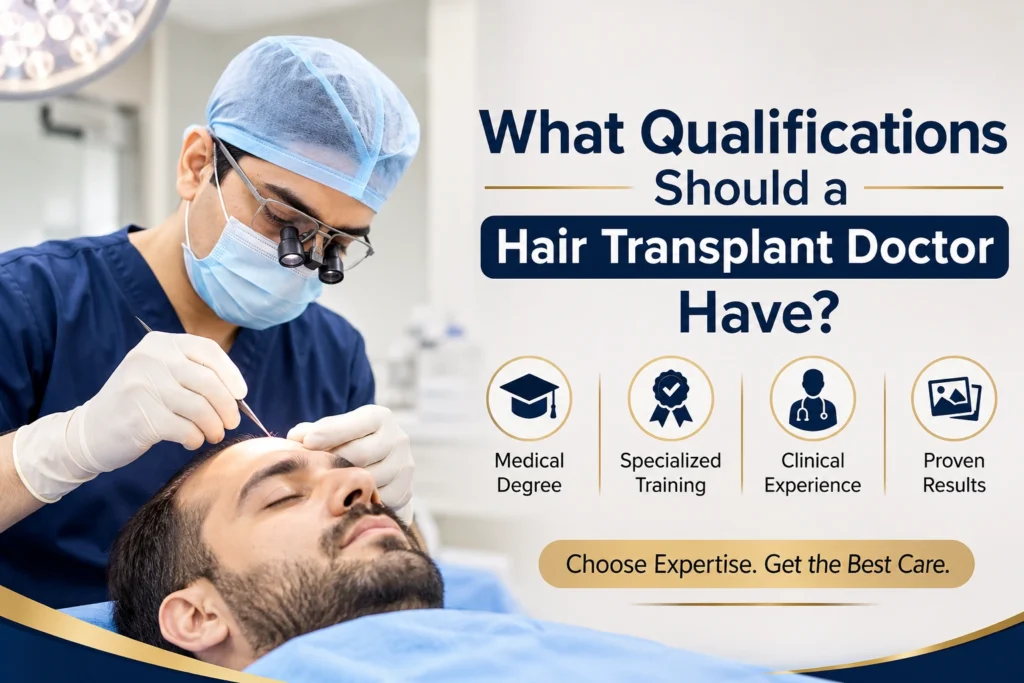
By Dr. Sukhbir Singh, Senior Consultant, Plastic & Cosmetic Surgeon, Renaissance Clinic India, Indirapuram, Ghaziabad. Published 18 November 2026.
A good hair transplant doctor should be a registered medical practitioner with a recognised surgical or dermatology postgraduate degree, such as MS General Surgery with MCh or DNB in Plastic Surgery, or MD in Dermatology. They should also have hair-restoration training, personally perform or supervise the critical steps of your surgery, and be willing to show verifiable results. Below is how to check each of these before you book.
A hair transplant is permanent. Your donor hair is a limited resource, and a poorly planned hairline or an over-harvested donor area is very hard to correct. That is why the doctor’s qualifications matter more than the price, the offer or the number of grafts quoted.
Quick checklist: what to verify
- Registration with the National Medical Commission (NMC) or a State Medical Council
- A postgraduate qualification: MD Dermatology, or MS General Surgery with MCh/DNB Plastic Surgery
- Hair-restoration training and relevant professional memberships
- Real, documented experience with both FUE and FUT, including results at 12 months
- A surgeon who does the planning, hairline design and key surgical steps
- A proper operating facility and a clear plan for complications
- Honest advice, including when you should not have surgery yet
Is there a legal qualification required to do hair transplants in India?
This surprises many patients. To our knowledge, there is no single hair-transplant-only degree that every clinic in India must hold, so a registered doctor can legally list hair transplant as a service. The responsibility to check training therefore falls on you. The International Society of Hair Restoration Surgery notes that each country has its own laws on what a doctor and a technician may do, and advises patients to ask who will actually perform the surgery (see ISHRS guidance on choosing a surgeon).
So “licensed” is the minimum, not proof of skill. The sections below explain what to look for beyond it.
Core medical qualifications to look for
Every hair transplant doctor should start with the same foundation: an MBBS and registration with the National Medical Commission (NMC) or a State Medical Council. After that, the most relevant postgraduate routes are:
Qualification | What it is | Why it matters for hair transplants |
|---|---|---|
MBBS | Basic medical degree | Legal minimum to practise medicine. Not enough on its own |
MD in Dermatology (DVL) | Postgraduate training in skin, hair and scalp conditions | Strong in diagnosing the cause of hair loss and medical management |
MS in General Surgery | Postgraduate surgical training | Builds the base in surgical safety, wound healing and anaesthesia |
MCh or DNB in Plastic Surgery | Super-specialty training in reconstructive and aesthetic surgery | Strong in tissue handling, scarring, hairline design and complication management. DNB is awarded by the National Board of Examinations in Medical Sciences |
Fellowship in cosmetic surgery or hair restoration | Additional focused training | Shows extra, procedure-specific training |
A short weekend course or a certificate from a private institute is not equal to a recognised postgraduate degree. If a clinic only says “hair transplant expert” without listing degrees, ask.
Dermatologist or plastic surgeon: who should do your hair transplant?
Patients often ask this, and the honest answer is that both can be excellent. What matters is the combination of three things: surgical training, an accurate diagnosis of your hair loss, and a large volume of hair transplant cases.
- A dermatologist brings depth in diagnosing conditions such as androgenetic alopecia, alopecia areata, scarring alopecia and thyroid or nutritional causes. Not every hair loss needs a transplant.
- A plastic surgeon brings formal operative training, skill in handling tissue and scars, and experience with facial aesthetics, which helps with natural hairline design.
- The best outcomes usually come from a doctor who understands both: why you are losing hair, and how to move follicles safely.
At Renaissance Clinic India, scalp assessment and medical options are discussed alongside surgical planning, so you are not pushed towards surgery when another approach may suit you better.
Hair-specific training and professional memberships
General surgical qualifications are the foundation. Hair restoration is a niche skill on top of it. Look for:
- Dedicated hair-restoration training, such as a fellowship, observership or hands-on workshops, not just online certificates
- Membership of recognised bodies, for example the International Society of Hair Restoration Surgery (ISHRS), the Association of Hair Restoration Surgeons – India (AHRS), the Association of Plastic Surgeons of India (APSI) or the International Society of Aesthetic Plastic Surgery (ISAPS)
- Continuing education, such as faculty roles or conference participation, which shows the doctor keeps up with changing techniques
A word of caution: membership of a society shows professional commitment and access to education, but it is not an exam that proves surgical skill. Treat memberships as one signal among several, and ask the doctor about their actual hair transplant experience.
Experience that actually counts
Qualifications open the door, but experience builds the result. In your consultation, ask:
- How many hair transplants have you personally performed, and for how many years?
- Do you perform both FUE and FUT, and how do you decide which suits me?
- Can I see unedited before-and-after photos at 12 months, not just day-one images?
- How do you design the hairline for my age, face shape and likely future hair loss?
- How do you protect my donor area so it still looks natural?
A young patient with early hair loss needs a very different plan from someone with stable, advanced baldness. A doctor who plans for the next 10 to 20 years, not just the next 12 months, is showing real experience.
Who will actually perform your surgery?
This is one of the most important questions and the least asked. Hair transplant is a team procedure, and trained assistants may help with tasks such as graft preparation. But the doctor should do the diagnosis, the treatment plan, the hairline design, the local anaesthesia and the key surgical steps, and should supervise the rest.
Ask directly: “Will you, personally, be doing my surgery, and who else will be involved?” Be careful if you only meet a sales coordinator before the day of surgery, or if the doctor is mentioned but never available to talk.
Clinic safety and facilities
The doctor’s degree is only part of safety. Also check that the clinic has:
- A clean, properly equipped procedure or operation room with sterile instruments
- Pre-surgery screening of your health, medicines and allergies
- A clear plan for emergencies and complications
- Written aftercare instructions and scheduled follow-up visits
- Transparent pricing. You can get a rough idea with the hair transplant cost calculator, and a final estimate after examination
Red flags to avoid
- No doctor name or qualifications listed on the website or in ads
- Promises of “100% guaranteed” results, “scarless” surgery or a fixed number of grafts before examining you. The ISHRS specifically warns about exaggerated claims like these
- Heavy discounts, “limited-time offers” and pressure to pay immediately
- Before-and-after photos that look edited, use different lighting or cannot be verified
- A doctor who says yes to everyone and never advises waiting or a non-surgical route
- Refusal to tell you who will perform each step of the surgery
How to verify a hair transplant doctor in India (step by step)
- Ask for the registration number and the State Medical Council name. It is usually printed on the prescription.
- Open the National Medical Commission website and go to Information Desk, then Indian Medical Register.
- Search by name or registration number and match the name, qualification and year of registration. If the record does not appear, also check the relevant State Medical Council, because registers are updated in stages.
- Cross-check the postgraduate degree (MD, MS, MCh, DNB) with what the clinic states.
- Look up the professional bodies the doctor mentions and ask to see certificates if you wish.
- Book a consultation and judge how the doctor explains risks, results and alternatives.
Qualifications of Dr. Sukhbir Singh at Renaissance Clinic India
Transparency should work both ways, so here is what we hold ourselves to. Dr. Sukhbir Singh is Senior Consultant, Plastic & Cosmetic Surgeon at Renaissance Clinic India. His training path is:
- MBBS from Kasturba Medical College
- MS in General Surgery from Sri Ramachandra University, Chennai
- DNB in Plastic Surgery, New Delhi
- Fellowship in Cosmetic Surgery, New Delhi
He is a Full Life Member of the Association of Plastic Surgeons of India (APSI), a Full Member of the Association of Hair Restoration Surgeons – India (AHRS), an Active Member of ISAPS, a Member of IAAPS and an International Member of the American Society of Plastic Surgeons (ASPS). His profile lists conference and faculty participation, including faculty at the AESURG ISAPS 2023 symposium.
We also tell patients plainly when a transplant is not the right step yet. If you are exploring options, read our page on hair transplant in Ghaziabad for FUE and FUT options, or hair transplant in Noida if you are travelling from Noida or nearby sectors.
Do you even need a transplant? Non-surgical options to discuss first
A qualified doctor will check whether your hair loss is stable, what is causing it and whether you are a candidate. In early or diffuse thinning, supportive treatments may be discussed before, or alongside, surgery:
- PRP treatment in Ghaziabad: platelet-rich plasma from your own blood, used as a supportive therapy
- GFC treatment: a growth-factor concentrate approach, also used as a supportive therapy
- Hair loss treatment in Ghaziabad: medical and procedural options matched to your diagnosis
Results vary from person to person. These treatments can support existing hair but are not a replacement for a transplant where there is established baldness, and your doctor should explain this honestly.
Frequently asked questions
What is the minimum qualification for a hair transplant doctor in India?
The minimum is an MBBS degree with registration on the National Medical Commission or a State Medical Council. For a procedure as permanent as a hair transplant, patients should look for more: a postgraduate degree such as MD Dermatology or MS General Surgery with MCh/DNB Plastic Surgery, plus hair-restoration training.
Can a dermatologist do a hair transplant?
Yes. Many dermatologists are trained in hair transplantation and are strong at diagnosing the cause of hair loss. What matters is their specific hair transplant training and experience, not just the specialty name.
Is a plastic surgeon better than a dermatologist for hair transplant?
Neither is automatically better. Plastic surgeons bring formal surgical and aesthetic training, and dermatologists bring depth in scalp and hair diagnosis. Choose the doctor with the right training, a record of hair transplant cases you can verify, and who will personally perform your surgery.
How do I check if my hair transplant doctor is registered?
Search the Indian Medical Register on the NMC website by name or registration number and match the qualification and state council. If you cannot find the record, also check the State Medical Council.
Should the doctor or a technician perform my hair transplant?
The doctor should handle diagnosis, planning, hairline design and the key surgical steps. Trained assistants may support other parts under supervision. Always ask who will do what before you book.
How long does it take to see hair transplant results?
Transplanted hairs usually shed in the first weeks and new growth begins in the following months, with the final result typically judged around 12 months. Timelines and results vary between patients.
Where can I consult a hair transplant doctor in Ghaziabad or Indirapuram?
You can consult Dr. Sukhbir Singh at Renaissance Clinic India, Gate No. 2, LGF, Jaipuria Mall, Ahinsa Khand 2, Indirapuram, Ghaziabad 201014. Call 93133 99990 or use the contact page to request an appointment.
Final thoughts: choose the surgeon before the technique
The right hair transplant doctor is registered, properly trained, experienced in hair restoration, transparent about who does what, and honest about risks. Check the degrees, verify the registration, ask the hard questions and compare more than one opinion if you wish. A little homework now protects a result you will live with for life.
If you would like a personal assessment, contact Renaissance Clinic India to book a consultation with Dr. Sukhbir Singh, or browse more hair care articles.
Book a consultation: Renaissance Clinic India, Gate No. 2, LGF, Jaipuria Mall, Ahinsa Khand 2, Indirapuram, Ghaziabad, Uttar Pradesh 201014 | Call 93133 99990 | 0120-4225557
Medical disclaimer: This article is for general information and does not replace an in-person consultation. Suitability for hair transplant, risks, recovery and results vary from person to person, and no outcome is guaranteed.