
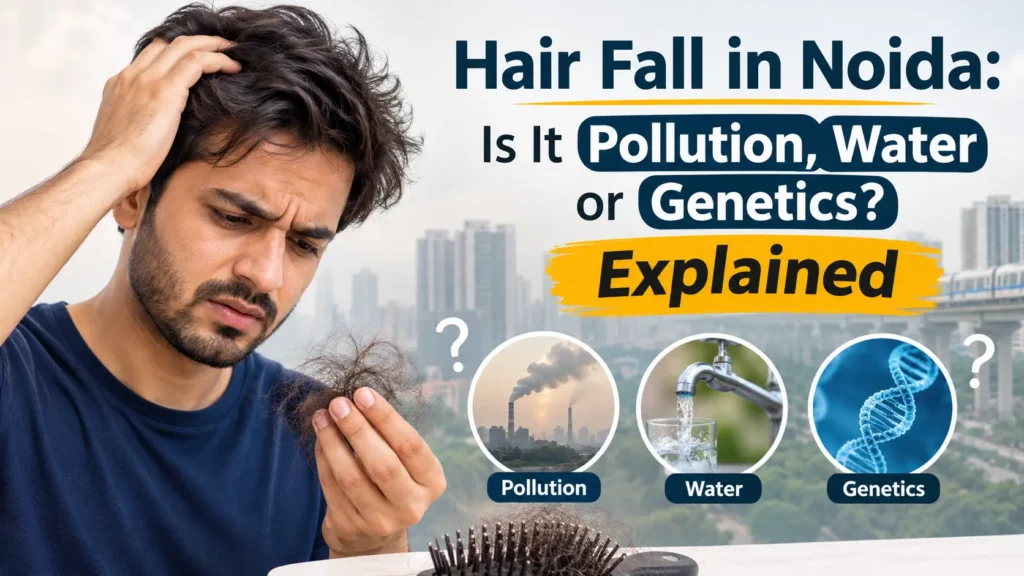
If you live in Noida, Greater Noida or anywhere in Delhi NCR, you have probably heard every explanation for hair fall: “It’s the pollution.” “It’s the hard water.” “It runs in your family.”
All three can play a role, but they don’t work the same way, and they don’t need the same solution. Treating the wrong cause is one of the biggest reasons people lose months (and hair) without improvement.
This guide explains how each factor affects your hair, how to tell which one is likely behind your hair fall, and when it’s time to see a specialist.
The Short Answer
| Factor | What it mainly does | Typical pattern |
|---|---|---|
| Genetics (DHT sensitivity) | Gradually shrinks follicles; causes permanent thinning | Receding hairline, crown thinning, widening part |
| Pollution | Irritates scalp, may stress follicles | Itchy, oily, dandruff-prone scalp; general thinning |
| Hard water | Weakens hair shaft, causes dryness and breakage | Rough, frizzy, brittle hair; snapped strands |
In most people, hair fall is multifactorial. Genetics often sets the stage, while pollution, water, stress and nutrition speed it up or make it more visible.
Is Pollution Causing Hair Fall in Noida?
Delhi NCR is known for high levels of particulate matter (PM2.5 and PM10), especially in winter months.
Research on this is still early, but it is worth knowing. A study presented at the European Academy of Dermatology and Venereology (EADV) Congress found that exposing human follicle dermal papilla cells to PM10-like dust and diesel particulate decreased hair-growth proteins in a dose-dependent manner. You can read the original EADV press release here. eurekalert
Important context: this was a laboratory study on cells, not proof that city air alone makes people bald. What we do see clinically is that pollution can:
- Deposit dust and grime on the scalp
- Aggravate dandruff, oiliness, itching and folliculitis
- Lead to over-washing with harsh shampoos, which dries the scalp further
- Add oxidative stress to an already vulnerable scalp
What this means for you: pollution is more likely to worsen existing hair loss than to be the only cause. Washing your hair regularly with a gentle shampoo and covering your hair on dusty commutes helps keep the scalp healthy, but it won’t reverse genetic thinning.
Is Hard Water Causing Hair Fall in Noida?
Groundwater across Noida and Ghaziabad is often hard, meaning it contains high levels of calcium and magnesium. Hard water can:
- Leave mineral residue on hair and scalp
- Make hair dry, rough and tangle-prone
- Reduce shampoo lather and cause product buildup
- Irritate sensitive or dandruff-prone scalps
This mostly causes hair breakage rather than true shedding from the root. That’s why many people install a shower filter, see softer hair, but still notice hair fall. (We cover this in detail in our guide on why hair fall continues even after installing a shower filter.)
How to tell the difference:
- Breakage: short, snapped pieces of hair with no root bulb
- Shedding: full-length hair with a small white bulb at the root
If you mainly see broken pieces, water and hair care habits are worth looking into. If you see full strands with bulbs, the cause is more likely internal.
Is Hair Fall in Noida Genetic?
For most people with long-term, progressive thinning, genetics is the biggest factor. This condition is called androgenetic alopecia, or pattern hair loss.
According to MedlinePlus Genetics, a variety of genetic and environmental factors likely play a role in causing androgenetic alopecia, and in women the hair becomes thinner at the top of the head and the middle part widens, while the hairline does not typically recede. You can read the full overview on MedlinePlus Genetics. medlineplusmedlineplus
Signs your hair fall may be genetic:
- A family history of hair loss on either side
- Receding hairline or temple thinning (men)
- Thinning at the crown
- Wider parting or reduced ponytail thickness (women)
- Hair becoming finer and shorter over time
- Gradual onset, usually starting in the 20s or 30s
Because the cause is built into how your follicles respond to hormones, no water filter, shampoo or oil can cure it. It does respond to medical treatment, particularly when started early.
Other Causes People Often Miss
Pollution, water and genetics get the attention, but these are just as common in Noida’s fast-paced lifestyle:
- Stress and long work hours: can trigger telogen effluvium, a sudden shedding that appears 2–3 months later
- Vitamin D, B12 and iron deficiency: widespread in urban India
- Thyroid disorders and PCOS: hormonal conditions that cause diffuse thinning
- Crash diets, poor sleep and illness
- Scalp infections and dandruff
- Certain medications
A hair specialist usually looks at all of these together.
How to Know Which Cause Is Behind Your Hair Fall
Ask yourself:
- Is the thinning in a specific pattern? Receding hairline or crown thinning points to genetics.
- Did shedding start suddenly after illness, stress or weight loss? That suggests telogen effluvium.
- Is my scalp itchy, flaky or oily? Look at scalp health and pollution.
- Is my hair brittle and rough, with broken pieces? Check hair care and water quality.
- Do I have fatigue, irregular periods or weight changes? Get thyroid and hormone checks.
If you can’t pin it down, that is exactly when professional diagnosis helps.
When to See a Hair Specialist
Book a consultation if:
- Hair fall continues for more than 2–3 months
- Your hairline is receding or your parting is widening
- You see round bald patches
- Hair is clearly getting thinner
- Over-the-counter products haven’t helped
- Hair loss comes with scalp pain, redness or other symptoms
At Renaissance Clinic, specialists including Dr. Sukhbir Singh and Dr. Ashish Chauhan examine your scalp, review your history and recommend a plan based on the actual cause.
Treatment Options by Cause
Treatment depends on what is driving your hair loss:
- Genetic thinning: medical therapies to slow loss and support follicles, and hair restoration when follicles are no longer active
- Scalp problems: targeted treatment for dandruff, folliculitis or inflammation
- Deficiencies and hormonal issues: correction under medical supervision
- Pollution and water exposure: scalp care routines, gentle cleansing and lifestyle changes
You can explore our approach to hair treatment in Ghaziabad for non-surgical options.
When Is a Hair Transplant the Right Choice?
If hair loss is advanced or permanent and medicines can no longer restore density, a hair transplant may be considered. It moves healthy, DHT-resistant hair from the back of the scalp to thinning areas.
- Learn about hair transplant in Noida
- Prefer a clinic closer to Ghaziabad? See hair transplant in Ghaziabad
- Planning your budget? Try our hair transplant cost calculator for an estimate
A transplant is not suitable for everyone, which is why an accurate diagnosis comes first.
Simple Daily Habits That Protect Your Hair in NCR
- Wash hair 2–3 times a week (or more if your scalp is very oily) with a gentle shampoo
- Cover your hair or use a clean scarf or cap during heavy-pollution days
- Avoid very hot water and tight hairstyles
- Use a shower filter or water softener if hard water is a concern, and change cartridges on time
- Eat enough protein, iron-rich foods and vitamin D sources
- Manage stress and sleep well
- Don’t self-medicate with strong products or supplements
These support scalp health, but they don’t replace treatment for genetic hair loss. For general background, the MedlinePlus article on male pattern baldness is a useful read.
Key Takeaways
- Genetics is the most common cause of progressive, long-term thinning
- Pollution may worsen scalp health and add stress to follicles, but the evidence is still developing
- Hard water mostly causes dryness and breakage rather than true baldness
- Most people have more than one contributing factor
- A proper diagnosis saves time, money and hair
Worried About Hair Fall in Noida?
Don’t spend more months guessing. Book a consultation at Renaissance Clinic to find out whether pollution, water, genetics or something else is behind your hair fall, and get a plan built around you.
Frequently Asked Questions
1. Is hair fall in Noida mainly caused by pollution?
Not usually on its own. Pollution can irritate the scalp and may stress follicles, but genetics, stress, nutrition and hormones are more common main causes.
2. Can hard water cause permanent hair loss?
Hard water mostly causes dryness, breakage and scalp irritation. It does not typically cause permanent pattern baldness.
3. How do I know if my hair loss is genetic?
Family history, a receding hairline or crown thinning, and gradual thinning over years suggest genetic hair loss. A specialist can confirm it with a scalp examination.
4. Will changing shampoo or installing a filter stop my hair fall?
It may improve hair feel and scalp comfort, but it won’t treat genetic, hormonal or nutritional causes.
5. Is hair fall normal?
Losing about 50–100 hairs per day is considered normal. Persistent excess shedding or visible thinning needs evaluation.
6. When should I consider a hair transplant?
When hair loss is stable but permanent and medical treatment can’t restore density. A specialist will check your donor area and overall suitability first.