
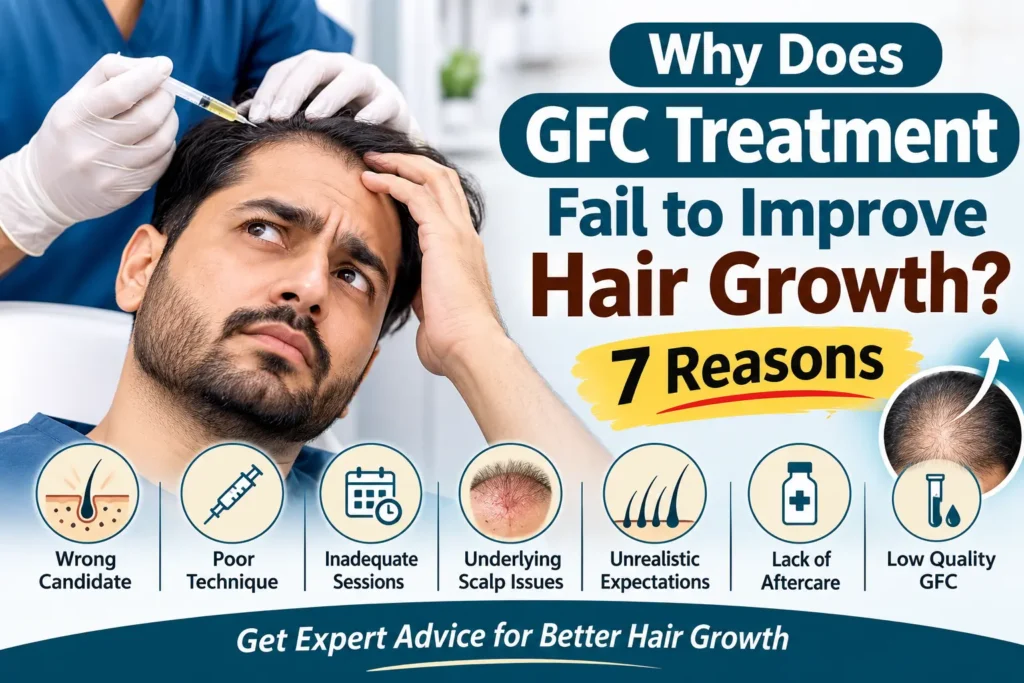
GFC treatment usually fails to improve hair growth for a handful of fixable reasons: the hair loss has a different cause, the follicles are too far gone, too few sessions were done, or an underlying problem was never treated. If you have finished a course of GFC and still see no change, it does not always mean the treatment is useless. It often means something in the plan needs to change.
This guide explains why GFC treatment sometimes disappoints, how to tell whether it is working, and what to do next. It is written for people in Ghaziabad, Indirapuram, Vasundhara and Vaishali who want honest answers before spending more on hair care.
What GFC can and cannot do
GFC stands for growth factor concentrate. A small blood sample is processed to isolate growth factors, which are proteins involved in tissue repair and follicle activity. The concentrate is then placed into the scalp to support hair follicles that are still alive but weakened.
The key words are support and still alive. GFC is not a cure for hair loss, and it cannot create follicles that no longer exist. It also does not remove the original reason your hair is thinning. Evidence for growth factor therapies is still developing, results vary from person to person, and no clinic can honestly guarantee an outcome.
With that in mind, here are the seven most common reasons results fall short.
1. The cause of your hair loss was never confirmed
This is the most common reason GFC “does not work”. Hair fall has many causes, and GFC is mainly discussed for early to moderate thinning where follicles are still active, such as pattern thinning at the crown or parting.
It is far less likely to help when the real cause is something else, for example:
- Sudden shedding after fever, surgery, childbirth or severe stress (telogen effluvium)
- Thyroid imbalance, low iron, low vitamin D or low vitamin B12
- Hormonal conditions such as PCOS
- Patchy hair loss from alopecia areata
- Scarring (cicatricial) alopecia, where follicles are destroyed
A proper scalp examination and, where needed, blood tests should come before any session. If you started GFC without this step, the treatment may have been aimed at the wrong target. Our hair loss treatment page explains how we approach diagnosis first.
2. The follicles are too damaged to respond
GFC works on follicles that are weakened but alive. In advanced pattern baldness, follicles shrink (miniaturise) over years until they stop producing visible hair. Smooth, shiny skin with no fine hairs is a sign that follicles may be inactive.
In that situation, even a well-done GFC course will usually show little or no change. This is not a failure of technique. It is a mismatch between the treatment and the stage of hair loss. When density cannot be restored by stimulating existing follicles, a hair transplant may need to be discussed, and an honest practitioner will tell you so rather than selling more sessions.
3. Too few sessions, or sessions spaced too far apart
GFC is normally given as a course, spaced a few weeks apart, followed by maintenance sessions if advised. One session rarely makes a visible difference.
Common patterns that reduce results:
- Stopping after one or two sessions because progress is not obvious
- Missing appointments and restarting months later
- Stopping maintenance and then seeing thinning continue
Pattern hair loss is ongoing. If treatment stops, the process that caused the thinning does not stop with it.
4. Results were judged too early
Hair grows slowly, so change is gradual and often takes several months to judge. Some people also notice extra shedding before improvement, because weak hairs fall out as new growth begins. This phase is alarming but can be part of the normal cycle.
A fair way to track progress is to take clear photos in the same light and angle before treatment and at each review visit, rather than relying on how your hair feels day to day. Judging at six weeks what needs four to six months is one of the main reasons people give up on GFC too soon.
5. An underlying problem is still active
GFC stimulates follicles, but it cannot cancel out what is switching them off. If any of these continue unchecked, results are usually weaker:
- Nutritional gaps, crash dieting or very low protein intake
- Untreated thyroid, hormonal or iron problems
- Ongoing high stress or poor sleep
- Smoking
- Medicines that cause hair shedding (always tell your doctor what you take)
Fixing these does not replace GFC. It gives GFC a better chance to show a result.
6. Scalp conditions were left untreated
A scalp with heavy dandruff, seborrhoeic dermatitis, fungal infection or chronic irritation is not a healthy base for new growth. Inflammation at the follicle can cancel out the benefit of treatment. Active scalp infection is also a reason GFC may not be advised at all until it is treated. If your scalp itches, flakes or feels sore, mention it at your first consultation.
7. GFC was used alone, or aftercare was ignored
GFC is usually part of a wider plan. For pattern hair loss, many people are also advised to use prescribed medicines, microneedling or other supportive care alongside it. Using GFC alone, when the case needed a combined approach, is a frequent reason for a flat result.
Aftercare matters too. Your practitioner will advise on washing, sun exposure and exercise for a short period after each session. Skipping those steps, or using harsh products on a treated scalp, can reduce comfort and results.
Technique also plays a part. The way the blood is processed and the concentrate is applied differ between clinics, which is why it is reasonable to ask your practitioner how the treatment is prepared and what a realistic timeline looks like.
How to tell whether GFC is working
Look for these signs across several months rather than a few weeks:
- Less hair on the pillow, comb and bathroom floor
- Short new hairs appearing along the parting or hairline
- Hairs that feel thicker rather than finer
- Better coverage in side-by-side photos taken in the same light
If you see none of these after a full course and a fair waiting period, it is time to review the plan with your doctor instead of repeating the same sessions.
What to do if GFC has not worked for you
- Get the diagnosis checked. Ask for a scalp assessment and relevant blood tests so the real cause is clear.
- Review your course. Count how many sessions you completed, how far apart they were, and whether maintenance was done.
- Treat the basics. Correct deficiencies, manage scalp conditions and follow aftercare.
- Ask about alternatives or combinations. PRP treatment keeps the platelets along with their growth factors and may suit some people differently from GFC. A broader hair regrowth therapy plan can combine several approaches. You can see the full range on our hair treatment in Ghaziabad page.
- Know when surgery is the honest answer. If the crown or hairline is completely bald with no active follicles, a transplant may be the realistic option.
Questions to ask before your next session
- What is the exact cause of my hair loss?
- Are my follicles still active?
- How many sessions do I need, and how far apart?
- What else should I be doing alongside GFC?
- When will we review progress, and what will we do if there is no change?
Frequently asked questions
Why is my hair still falling after GFC?
Shedding can continue, or even increase briefly, as weak hairs make way for new growth. If heavy shedding lasts beyond a few months, ask your doctor to look for an underlying cause.
How long should I wait before deciding GFC has failed?
Change is gradual, and it usually takes several months to judge. Review progress at the visits your practitioner schedules, using photos taken in the same conditions.
Can GFC fail even when it is done correctly?
Yes. Results vary with age, the cause of hair loss and the stage of follicle damage. GFC is not a cure, and no result can be guaranteed.
Is GFC better than PRP?
Neither is better for everyone. Both use your own blood but are processed differently, and the right choice depends on your scalp and goals. Your practitioner can explain which may suit you.
Can I repeat GFC if it did not work?
Repeating the same plan without finding out why it failed rarely helps. Review the diagnosis and the course first, then decide whether to repeat, combine or change treatment.
Who should avoid GFC?
GFC may not be advised with an active scalp infection, certain blood disorders, or during pregnancy. Areas of complete baldness with no active follicles are also unlikely to respond.
Talk to a doctor before you spend more
If your GFC course has not given the result you hoped for, a fresh assessment can show whether the problem is the diagnosis, the plan or the stage of hair loss. At Renaissance Clinic India, Dr. Ashish Chauhan, Aesthetic Physician, can review your history and discuss suitable options, session plans and costs with you.
Renaissance Clinic India, Gate No. 2, LGF, Jaipuria Mall, Ahinsa Khand 2, Indirapuram, Ghaziabad, Uttar Pradesh 201014.
Call 93133 99990 or request a consultation.
This article is for general information and does not replace a medical consultation. Results vary and no outcome can be guaranteed.