
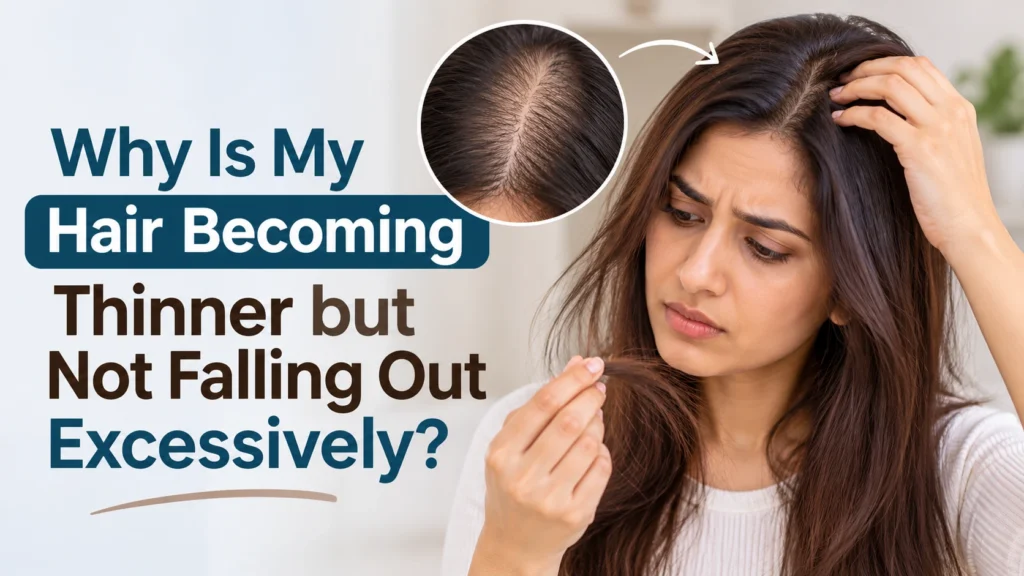
Your comb is not full of hair. Your shower drain is fine. Yet your parting looks wider, your ponytail feels slimmer and your hair just does not look as full as it used to. If that sounds familiar, you are not imagining it, and you are not alone. Here is the encouraging part: hair that is getting thinner without heavy shedding is very common, it usually has an identifiable cause, and acting early gives you the most options.
At Renaissance Clinic India, we see this pattern every week. This guide explains what is really happening and what can help.
Quick Answer: Why Does Hair Thin Without Falling Out a Lot?
Hair can look thinner without heavy shedding because the individual strands are becoming finer and shorter, not because large amounts of hair are falling out. This process, called follicle miniaturization, is the hallmark of genetic pattern hair loss (androgenetic alopecia). Nutritional gaps, thyroid or hormonal changes, low-grade stress, ageing and hair-care habits can also make hair look and feel thinner. A proper diagnosis finds the cause, and the earlier you act, the more hair you can usually protect.
What Is Actually Happening Inside Your Hair Follicles?
Think of each hair follicle as a tiny factory. In healthy hair, the factory produces thick, long, pigmented strands. In pattern hair loss, certain follicles become sensitive to the hormone DHT and slowly shrink with every growth cycle. A shrinking follicle produces a finer, shorter hair, until the strand is barely visible, like peach fuzz. The follicle may even stop producing visible hair altogether.
The International Society of Hair Restoration Surgery explains in its guide to androgenetic alopecia that although shedding can be part of the condition, it usually presents as simple, progressive thinning of the hair. That is why many people see their hair becoming thinner long before they notice heavy hair fall.
Signs of Thinning Without Heavy Shedding
You may be experiencing this type of thinning if you notice:
- A parting that looks wider than before
- A ponytail or bun that feels thinner in your hand
- Finer, softer, shorter “baby” hairs, especially at the hairline or crown
- More of the scalp visible under bright light
- Hair that no longer holds volume or styles the way it used to
- Thinning at the temples, crown or top of the scalp
If you notice two or more of these over several months, it is worth getting checked.
7 Common Reasons Hair Becomes Thinner Without Excessive Fall
1. Genetic pattern hair loss (the most common reason)
Pattern hair loss is inherited and is the most common cause of gradual thinning in men and women. In men, it often shows as a receding hairline or thinning crown. In women, it typically appears as thinning over the top and crown with a widening parting, and the frontal hairline is often spared. A review of female pattern hair loss on PubMed Central describes it as a slowly progressive thinning caused by follicular miniaturization, which may or may not come with increased shedding.
2. Nutritional gaps
Low iron, low protein, low vitamin D and zinc deficiency can weaken hair and make strands finer. Crash diets, skipped meals and restrictive eating are common triggers, especially in busy professionals and young women. A simple blood test can check these levels.
3. Thyroid and hormonal changes
An underactive or overactive thyroid can make hair thinner and more brittle. Hormonal shifts, including those around pregnancy, postpartum and conditions that affect androgen levels, may also play a role. These are identified through clinical evaluation and blood tests.
4. Ongoing low-grade stress
Sudden stress can cause heavy shedding, but long-term background stress, poor sleep and burnout can also quietly disturb the hair cycle, leaving hair looking less full over time.
5. Natural ageing
As we age, hair growth slows and strands tend to become finer. This is normal to a degree, but if the change feels faster than expected, a check-up can rule out other causes.
6. Hair care habits and physical stress on the hair
Tight hairstyles, frequent heat styling, bleaching, colouring and harsh brushing can weaken the hair shaft. Over years, constant pulling can also contribute to thinning around the hairline. The scalp may look fine, so the link often goes unnoticed.
7. Medicines and medical conditions
Some medicines and health conditions can thin hair as a side effect. Never stop a prescribed medicine on your own. Speak with your doctor first.
How Is the Cause Found?
Two people with “thinning hair” can need very different plans. A thorough evaluation usually includes:
- A detailed history of your health, diet, stress, medicines and family history
- A close scalp and follicle examination, sometimes with magnified imaging to compare thick and fine hairs
- A gentle hair pull test to see whether shedding is active
- Blood tests where needed, such as thyroid function, iron levels and vitamin D
A proper assessment replaces guesswork. Without it, any supplement, topical product or treatment is a shot in the dark.
The Hopeful Part: What Can Help
The right plan depends on the cause. Your doctor may recommend one or a combination of the following.
Fix what is fixable first
Correcting low iron or vitamin levels, managing thyroid conditions and improving sleep, nutrition and stress can all help your hair look and feel fuller.
A personalised medical hair treatment plan
For pattern hair loss, doctor-prescribed treatments can help slow further thinning and support the hair you still have. Please never self-prescribe, because suitability differs between men and women and from person to person. See how plans are tailored at our hair treatment in Ghaziabad and Indirapuram page.
PRP therapy
Platelet-rich plasma uses components of your own blood, concentrated and placed into the scalp, with the aim of supporting weakened follicles and encouraging healthier growth. Learn more about PRP treatment in Ghaziabad.
GFC therapy
Growth factor concentrate is a related plasma-based approach that focuses on growth factors for follicle support, and it may be suggested where thinning is early to moderate. Read about GFC treatment in Ghaziabad.
Hair transplant for areas that have stopped producing hair
If follicles in certain areas have stopped producing visible hair, a transplant can restore density by relocating healthy, resistant hair to those zones. It works best as part of a long-term plan, often alongside medical treatment. Explore our hair transplant in Ghaziabad or, if Noida is closer, our hair transplant in Noida page.
Results vary from person to person, and no treatment suits every cause. That is exactly why diagnosis always comes first.
Why Early Action Is Your Biggest Advantage
Thinning without heavy shedding can be easy to ignore because it is gradual. But follicles that are shrinking are often easier to support than follicles that have stopped producing hair completely. Seeing a doctor at the first signs, rather than after years of waiting, usually means more treatment choices, simpler plans and a better chance of keeping the hair you have.
Everyday Habits That Support Fuller-Looking Hair
- Eat balanced meals with enough protein, iron-rich foods, fruits and vegetables
- Avoid crash diets and long gaps between meals
- Go easy on heat styling, tight hairstyles and chemical treatments
- Sleep well and find healthy ways to manage stress
- Avoid starting random supplements or strong products without medical advice
- Take photos of your parting and hairline every month in the same light, to track changes
When Should You See a Doctor?
Book a consultation if:
- Your parting has widened or your hairline is changing
- You see thinning at the crown, temples or top of the scalp
- A family member has had pattern hair loss
- You also have fatigue, weight changes, irregular periods or feel unusually cold
- Home remedies have not helped after a few months
The Bottom Line
Hair that is getting thinner without falling out in clumps is easy to dismiss, but it is often the earliest and most treatable stage of hair loss. Understanding why it is happening turns worry into a plan. The most hopeful step you can take today is to get clarity.
Ready for clear answers about your hair? Visit Renaissance Clinic India and book a consultation. We will help you understand the cause and plan the right treatment for you.
Frequently Asked Questions
Why is my hair getting thinner but not falling out much? The strands themselves may be becoming finer and shorter because follicles are shrinking, which is typical of genetic pattern hair loss. Nutritional gaps, thyroid or hormonal changes, stress and hair-care habits can also make hair look thinner.
Is hair thinning without shedding a sign of baldness? Not necessarily, but it can be an early sign of pattern hair loss. Early diagnosis helps your doctor choose the right treatment and protect the hair you still have.
Can thinning hair grow back thicker? It depends on the cause. When the cause is a nutritional gap or a treatable medical issue, hair often improves once it is corrected. In pattern hair loss, treatment aims to slow thinning and support finer hairs, and results vary by person.
Which tests are done for thinning hair? Doctors may do a scalp and follicle examination and a hair pull test, and may check thyroid function, iron levels and vitamin D through blood tests, along with a review of your medical and family history.
Can PRP or GFC treatment help thinning hair? PRP and GFC are used to support follicle health and may help some people with early to moderate thinning. Suitability and results depend on the cause and the individual, so a consultation is needed first.
When is a hair transplant needed for thinning hair? A hair transplant is usually considered when follicles in certain areas have stopped producing visible hair and the cause has been properly diagnosed. Your doctor will advise on timing and planning.