
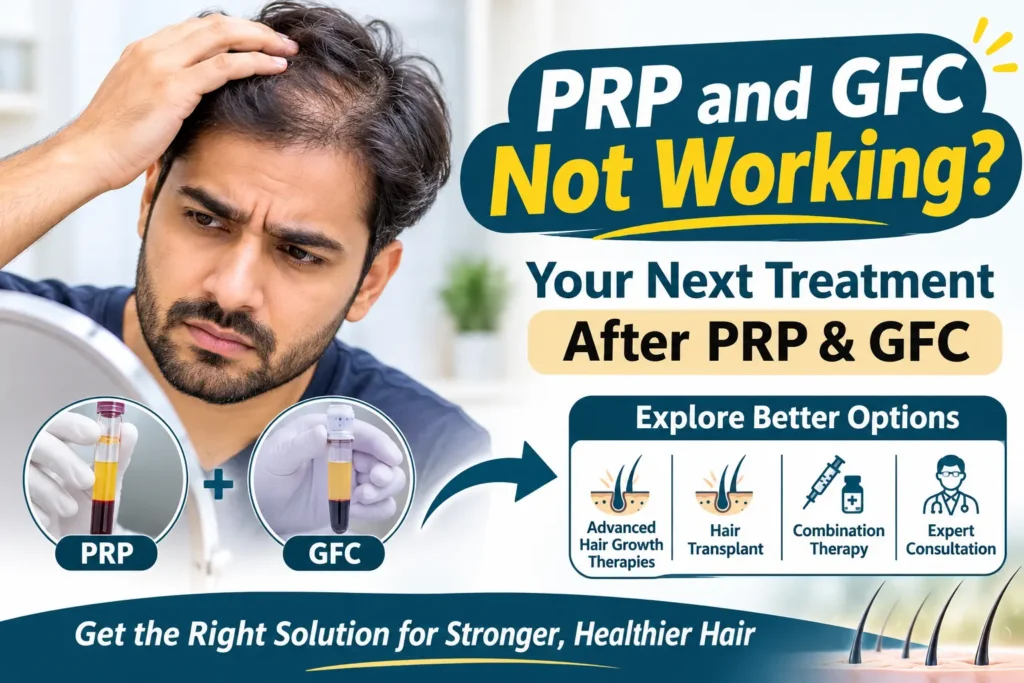
If PRP and GFC have both failed to improve your hair, do not book a third round of the same treatment. Stop, get the diagnosis rechecked, and then choose the next step based on whether your follicles are still active: fix the underlying cause, build a combined plan, or, if the follicles are no longer producing hair, consider a hair transplant.
This guide explains why both treatments can fall short, what to review first, and which options usually come next. It is written for people in Ghaziabad, Indirapuram, Vasundhara and Vaishali who have already spent time and money on hair treatment and want a clear, honest way forward.
Why PRP and GFC can both fail
PRP treatment uses platelet-rich plasma from your own blood, while GFC treatment uses a concentrate of growth factors with the platelets removed. They are prepared differently, but both aim to support follicles that are weakened and still alive.
That shared aim is why they often fail for the same reasons:
- The real cause of hair loss was never confirmed, so the treatment targeted the wrong problem
- The follicles are too miniaturised or inactive to respond
- An underlying issue such as low iron, thyroid imbalance or a scalp condition is still active
- The course was too short, too widely spaced, or judged too early
- The treatment was used alone when the case needed a combined plan
We cover each of these in detail in our guide on why GFC treatment sometimes fails to improve hair growth. If both PRP and GFC have failed, the odds are high that the problem lies in the diagnosis or the stage of hair loss, not in which blood-derived treatment you picked.
Step 1: Stop and reassess before any new session
Before choosing a next treatment, collect the facts. A good review covers:
- Your course: how many PRP and GFC sessions you completed, how far apart they were, and whether maintenance was done
- Your timeline: how long it has been since the last session, because change takes several months to judge
- Your photos: same-light, same-angle photos from before treatment to now
- Your diagnosis: a scalp examination and, where needed, blood tests for iron, vitamin D, vitamin B12 and thyroid function
- Your follicle status: whether fine, short hairs are still present in the thinning area or the skin is smooth and shiny
The last point matters most. Weakened follicles can often be supported. Follicles that have stopped producing hair cannot be revived by injections of any kind.
Which next treatment fits your situation
The right next step depends on what the reassessment shows. This table summarises the usual direction. Your doctor should confirm it after examining your scalp.
What the assessment shows | Usual next step |
|---|---|
A treatable cause is still active (low iron, thyroid, vitamin gaps, scalp condition) | Correct the cause first, then restart a supportive plan |
Early to moderate thinning, follicles still active, but only injections were used | A combined hair regrowth therapy plan |
Pattern thinning that needs ongoing control | Doctor-prescribed medicines alongside in-clinic sessions |
Thin-looking hair where cosmetic coverage is the goal | Supportive options such as hair filler treatment |
Bald areas with no active follicles, adequate donor hair available | A hair transplant consultation |
Patchy loss, scarring, redness or pain | Medical diagnosis first, since this may not be pattern hair loss |
Your main options after PRP and GFC fail
1. Treat the underlying cause
If your blood tests or scalp exam show a deficiency, thyroid or hormonal issue, dandruff, seborrhoeic dermatitis or another scalp condition, that comes first. Injections cannot overcome a problem that keeps switching follicles off. Our hair loss treatment page explains how we approach diagnosis before any procedure.
2. A combined, personalised regrowth plan
PRP or GFC on their own are often not enough for pattern hair loss. A personalised plan may combine in-clinic sessions with microneedling for hair and topical or oral support, chosen after assessment. This is the approach described on our hair treatment in Ghaziabad page: a plan built around your pattern, not a standard package.
3. Doctor-prescribed medicines
For androgenetic (pattern) hair loss, doctors commonly use topical minoxidil, and in some men oral medicines such as finasteride. These are not suitable for everyone, can have side effects, and are not advised in certain situations such as pregnancy, so they should only be started after a medical assessment. Stopping them usually allows thinning to resume, which is why they are treated as long-term care.
4. Hair filler for the look of density
Where the goal is a fuller appearance rather than new growth, hair filler treatment may be discussed as injectable support for thicker-looking hair. It is a cosmetic option and does not replace treatment for the cause of hair loss.
5. Hair transplant when follicles are no longer active
When the crown or hairline is truly bald and no active follicles remain, a hair transplant is usually the realistic option. It relocates your own follicles from a donor area, so it needs enough healthy donor hair and a stable pattern of loss. It is not right for everyone, and an honest doctor will say so. You can estimate your plan using our hair transplant cost calculator before a consultation.
Mistakes to avoid after both treatments fail
- Repeating PRP or GFC unchanged. A third identical course rarely works if the first two did not.
- Switching clinics every few weeks. Each new plan needs months to judge, so constant changes make it impossible to know what works.
- Buying unproven products. Sprays, supplements and miracle oils sold with guaranteed claims rarely have solid evidence.
- Stopping prescribed medicines suddenly. This can bring shedding back.
- Expecting a guarantee. No clinic can promise full regrowth, and anyone who does should be questioned.
When to see a doctor sooner
Book a prompt assessment if you notice sudden patchy hair loss, a painful or burning scalp, redness, scaling or pus, scarring, or rapid shedding after illness, new medicines or childbirth. These can point to conditions that need diagnosis rather than another cosmetic procedure.
Questions to ask at your next consultation
- What is the exact cause of my hair loss, and how was it confirmed?
- Are my follicles still active in the thinning area?
- Why do you think PRP and GFC did not work for me?
- What is the plan, how many sessions, and when do we review it?
- What will we do if this plan also fails?
Frequently asked questions
What should I do if PRP and GFC both fail?
Do not repeat the same course. Get the diagnosis rechecked, confirm whether your follicles are still active, and then discuss a different or combined plan with your doctor.
Can I try PRP again after GFC failed?
Repeating the same approach without finding out why it failed rarely helps. Review the diagnosis and your course first, then decide whether to repeat, combine or change treatment.
Is a hair transplant the next step after PRP and GFC?
Only if your follicles are no longer active and you have enough healthy donor hair. For early to moderate thinning, a combined non-surgical plan is usually discussed first.
How long should I wait before deciding PRP or GFC has failed?
Change is gradual and usually takes several months to judge. Review progress with photos taken in the same conditions at the visits your practitioner schedules.
Are there non-surgical options besides PRP and GFC?
Yes. Depending on your assessment, options can include correcting underlying causes, microneedling, doctor-prescribed medicines and a combined regrowth therapy plan.
Why did PRP and GFC work for someone else but not for me?
Results vary with age, the cause of hair loss, the stage of follicle damage and how well the plan was followed. No result can be guaranteed for any individual.
Talk to a doctor before your next treatment
If PRP and GFC have not given the result you hoped for, a fresh assessment can show whether the problem is the diagnosis, the plan or the stage of hair loss. At Renaissance Clinic India, Dr. Ashish Chauhan can review your history and discuss suitable options, session plans and costs.
Renaissance Clinic India, Gate No. 2, LGF, Jaipuria Mall, Ahinsa Khand 2, Indirapuram, Ghaziabad, Uttar Pradesh 201014.
Call 93133 99990 or request a consultation.
This article is for general information and does not replace a medical consultation. Results vary and no outcome can be guaranteed.